RATTMMOTOR DIY CNC Router Kit Review: Is This Beginner Desktop CNC Worth It in 2026?
The single biggest hurdle for first-time CNC buyers is finding a beginner kit that actually teaches the fundamentals without being a frustrating dead end. Most ultra-budget DIY CNC kits ship with proprietary control boards, no safety port support, no upgrade paths, and electronics that fail when MDF dust hits them. The RATTMMOTOR DIY CNC Router Kit solves this with an updated GRBL control board that includes emergency stop port support, X/Y/Z axis limit switch ports, PWM spindle control, a silent cooling fan, and offline controller auto-identification.
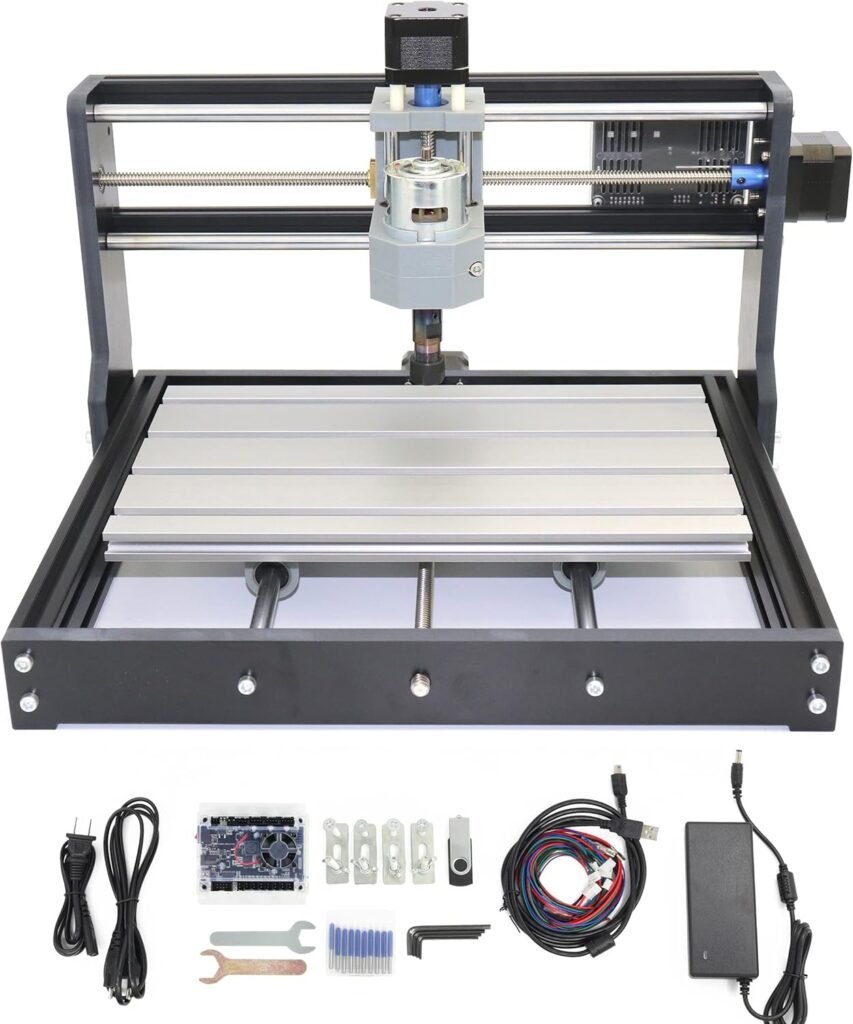

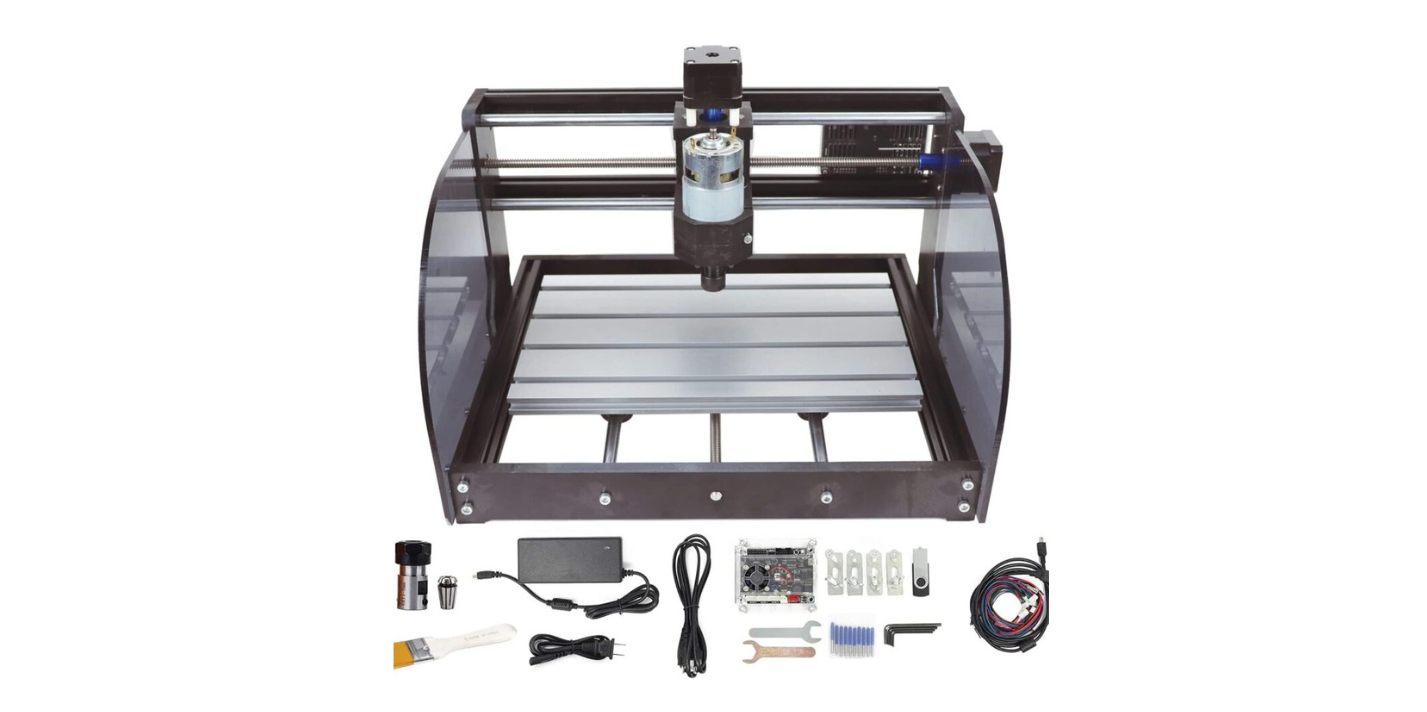
The package pairs that updated controller with a 3-axis aluminum-alloy working table, black injection-molded external frame, stainless steel screw rods driving X/Y/Z motion, NEMA17 (42-frame) stepper motors at 1.3A phase current with 0.25N·m torque, and a 775 DC spindle motor running at 12-24V (10,000 rpm at 24V). A USB flash drive ships with software, drivers, sample G-code files, and a paper manual that prioritizes pictures over walls of text.
Important working area note: The Amazon listing title states 300 x 180 x 45mm, while the listing’s spec text states 18 x 10 x 4.5cm (180 x 100 x 45mm). Both sources agree on the imperial measurement of 11.8 x 7.1 x 1.8 inches. Plan around the inch measurement, which corresponds to roughly 300 x 180 x 45mm. Verify exact dimensions with the seller before designing fixtures or large parts.
This review contains affiliate links. If you buy through them, we may earn a commission, at no extra cost to you.
Who should buy: First-time CNC users learning fundamentals, hobbyists making personalized signs and PCB prototypes, classrooms and makerspaces teaching GRBL basics, Etsy sellers producing small wood and acrylic items, and tinkerers who appreciate clear upgrade paths over time.
Who should skip: Anyone needing steel cutting capability, larger work envelopes, production-rate aluminum throughput, or fully enclosed turnkey systems with no DIY assembly required.

RATTMMOTOR DIY CNC Router Kit, 3 Axis Hobby CNC Router Machine GRBL Control, Plastic Acrylic PVC PCB Wood Mini Desktop Engraving Milling Carving Machine, Working Area 300x180x45mm
Quick Verdict: RATTMMOTOR DIY CNC Router Kit
The RATTMMOTOR kit delivers what budget DIY CNC buyers actually need: a GRBL-compatible control board with proper safety port support, an aluminum alloy working table for genuine flatness, stainless steel screw rods for predictable motion, and PWM spindle control for variable speed. The 11.8 x 7.1 inch working area handles small signs, PCB prototypes, custom keychains, jewelry pieces, and light aluminum work confidently.
The trade-offs are honest at this price tier: the injection-molded external frame trades industrial rigidity for affordability, the 1.8 inch Z-travel restricts taller stock, and limit switches plus E-stop button must be added separately. Match the machine to its scope and the value math works clearly.
- Best for: Beginners, classrooms, PCB prototyping, small craft work, hobbyist tinkerers
- Skip it if: Need steel cutting, larger work areas, production aluminum, or enclosed safety
- Standout features: Updated GRBL board with full port suite, aluminum alloy bed, stainless steel screw rods, 775 DC spindle
- Main compromises: Injection-molded external frame, 1.8 inch Z-travel, working area metric vs imperial discrepancy
RATTMMOTOR DIY CNC Router Kit Specifications
| Brand | RATTMMOTOR (Manufacturer: RTM) |
| Model | 3018PRO |
| Frame size | 420 x 350 x 270mm (16.53 x 13.78 x 10.63 inch) |
| Working area | 11.8 x 7.1 x 1.8 inch (verify metric with seller) |
| External frame material | Black injection-molded plastic |
| Working table material | Aluminum alloy |
| Screw rods | Stainless steel |
| Spindle motor | 775 DC, 12-24V, 10,000 rpm at 24V |
| Stepper motors | NEMA17 (42-frame), 12V, 1.3A phase current, 2.1 ohm phase resistance, 0.25N·m torque |
| Control board | Updated GRBL with PWM, silent cooling fan, offline controller auto-ID |
| Safety port support | E-stop port, X/Y/Z axis limit switch ports (switches sold separately) |
| Voltage | 24V DC |
| Item weight | 6.64 kg |
| Compatible materials | Wood, plastic, acrylic, PVC, PCB, carbon fiber, density board, copper, aluminum |
| Not for | Hard metals, glass, jade, brittle materials |
| Included | Paper manual, USB flash drive with software/drivers/samples |
Key Features Tested: Where the RATTMMOTOR Kit Earns Its Price
Updated GRBL Control Board with Full Port Suite
The control board separates this kit from cheaper DIY alternatives. The updated GRBL implementation includes ports and features that beginners need as they grow into intermediate users:
- Emergency stop port: Wire a proper E-stop button for instant power-down during runaway jobs
- X/Y/Z axis limit switch ports: Enable homing cycles and travel limits when switches are added
- PWM spindle control: Variable spindle speed control through G-code S commands
- Silent cooling fan: Active thermal management without the high-pitched whine of cheap fans
- Offline controller auto-identification: Plug-and-play recognition of optional offline controllers
The board does not ship with limit switches or an E-stop button installed. Buyers need to add these separately, which costs $10-$20 in parts and an hour of basic wiring. The ports exist on the board itself, so adding the safety hardware is a beginner-friendly upgrade rather than a hardware modification.
Aluminum Alloy Working Table with Stainless Steel Screw Rods
The working table is genuine aluminum alloy, not plastic with an aluminum sticker. This matters for flatness, durability, and the ability to mount workholding hardware reliably. The stainless steel screw rods driving X/Y/Z motion deliver predictable, repeatable movement with less backlash than belt-driven motion at this price point. The trade-off is slightly slower maximum feed rates compared to belt-driven alternatives.
The black injection-molded external frame trades industrial rigidity for affordability and ease of assembly. For the hobby-tier projects this kit targets, the frame holds the working table and gantry components in alignment without flexing under typical cutting loads. Aggressive aluminum work or heavy hardwood roughing reveals the frame’s limits.
775 DC Spindle Motor with PWM Control
The 775 DC motor delivers up to 10,000 rpm at 24V. Compared to higher-end 800W spindles, the 775 motor produces less torque under load but runs quieter, costs less, and replaces easily when worn. The PWM control on the GRBL board enables variable speed, which matters for matching spindle RPM to material and bit selection.
For wood, plastics, PCB, and light aluminum work, the 775 spindle hits the sweet spot of capability versus cost. For steel, hardened metals, or production-rate aluminum, you need a different machine class entirely.
NEMA17 Stepper Motors
The NEMA17 (42-frame) stepper motors at 1.3A phase current and 0.25N·m torque are standard for 3018-class kits. The torque is sufficient for the cutting forces involved at this scale, and the motors handle X/Y/Z motion without skipping under typical hobby loads. NEMA23 platforms like the Genmitsu PROVerXL 6050 Plus deliver more torque for serious production, but at significantly higher cost.
Performance by Material
| Material | Performance | Settings (1/8 inch tooling) |
| Softwood (pine, basswood) | Excellent | 10,000 rpm, 400-600 mm/min, 0.5-1.0mm DOC, 2-flute upcut |
| Hardwood (maple, oak) | Excellent | 10,000 rpm, 300-500 mm/min, 0.3-0.7mm DOC, 2-flute upcut |
| MDF / Density board | Excellent | 10,000 rpm, 400-700 mm/min, 0.7-1.0mm DOC, dust extraction critical |
| Cast acrylic | Very good | 10,000 rpm, 300-600 mm/min, 0.3-0.6mm DOC, single-flute O-flute |
| PVC | Good | Conservative feeds, mind fumes |
| PCB (FR-4) | Excellent | 30 degree V-bit, 0.05-0.08mm DOC, very shallow passes |
| Carbon fiber | Possible with care | Dust extraction and PPE non-negotiable |
| Aluminum 6061 | Light passes only | 10,000 rpm, 200-400 mm/min, 0.1-0.3mm DOC, 1-flute carbide |
| Copper | Capable | Sharp single-flute bits, conservative feeds |
| Steel / hard metals / glass | Not supported | Wrong machine class |
Wood: The Comfort Zone
Wood is where this machine genuinely performs above its price tier. Hardwoods like maple and walnut produce clean V-carved letters with sharp bits. Softwoods cut quickly with 2-flute upcut end mills. For plywood, compression bits prevent the top-surface tear-out that ruins otherwise good projects. MDF requires aggressive dust extraction, the fine particles cling to ball screws, rails, and electronics.
PCB Prototyping: A Standout Use Case
The combination of GRBL precision, stainless steel screw rod motion, and PWM-controlled spindle makes this kit one of the more capable PCB prototyping platforms in its price tier. Surface the spoilboard first with a flat end mill, use a Z-touch probe (sold separately) for consistent depth, and run autoleveling software like FlatCAM if your board has any warpage. FR-1 boards mill more easily than FR-4 due to softer composition.
Aluminum: Patience Required
Aluminum work demands patience. Use sharp single-flute carbide bits, very shallow stepdowns (0.1-0.3mm DOC), conservative feeds, and short tool stick-out for rigidity. Realistic capability covers small nameplates, custom brackets, faceplates, and prototype components. The 775 spindle and injection-molded external frame are the limits, not the technique. Don’t expect production aluminum throughput.
Setup and First Cuts
The RATTMMOTOR kit requires more assembly than higher-tier desktop CNCs. Realistic time from unboxing to first jog: 2-4 hours for first-time builders, faster for experienced makers. The included paper manual prioritizes pictures over text, and labeled parts make the process manageable.
Setup Sequence
- Unbox and inventory hardware against the parts list
- Lay out fasteners in small cups for organized assembly
- Loosely assemble the frame first, then square the gantry to the bed before final torque
- Verify lead screws are straight and parallel to the rails
- Mount the 775 spindle in its holder
- Connect labeled wiring to the GRBL control board’s terminals
- Route cables cleanly without strain on connectors
- Install drivers and software from the included USB flash drive
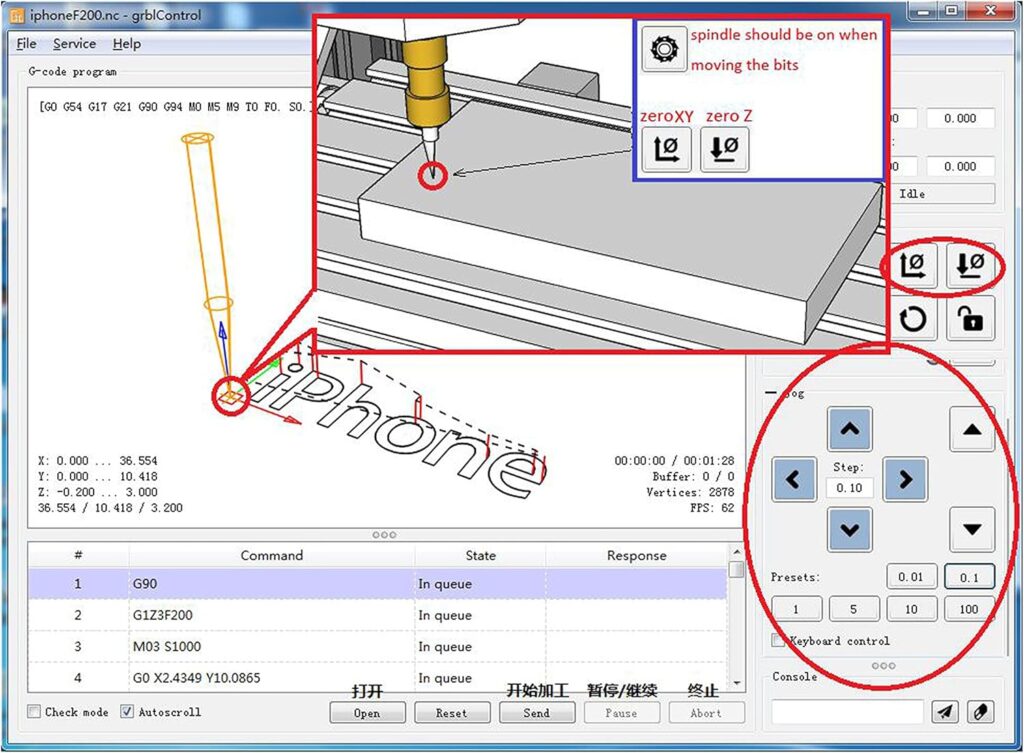
- Connect to computer via USB, verify COM port
- Open Candle or Universal G-code Sender, confirm GRBL handshake
- Run a test cut in scrap MDF to verify dimensional accuracy
Recommended Starter Tooling
- 1/8 inch 2-flute upcut end mill for general wood pocketing
- 1/8 inch single-flute O-flute for plastics and aluminum
- 1/16 inch end mill for fine wood detail and PCB work
- 20-60 degree V-bit set for engraving and inlays
- 0.1-0.2mm V-bit for PCB isolation routing
Software and Workflow
GRBL compatibility means the machine works with all standard senders:
- Candle: Beginner-friendly Windows interface, often bundled with 3018-class kits
- Universal G-code Sender (UGS): Cross-platform, mature, free
- OpenBuilds CONTROL: Modern, clean interface
For CAM, Fusion 360 (free for personal use) handles complex 3D toolpaths. Carbide Create works well for simpler 2D projects. Inkscape with the gcodetools extension covers basic 2D vectors for free. The standard G-code post-processor for GRBL works without modification.
RATTMMOTOR DIY CNC Router Kit vs Alternatives
| Machine | Spindle | Working Area | Frame | Best For |
|---|---|---|---|---|
| RATTMMOTOR DIY CNC Router Kit | 775 (10k rpm) | 11.8 x 7.1 x 1.8 inch | Injection-molded + aluminum bed | Beginner DIY learning |
| CNCTOPBAOS 3018-PRO-MAX | 775 120W (10k rpm) | 11.8 x 7.1 x 1.8 inch | Aluminum frame | Beginners with cased board priority |
| Twotrees TTC3018 | 775 (10k rpm) | 11.8 x 7.1 x 1.6 inch | Aluminum | WiFi connectivity priority |
| Genmitsu 3018-PROVer V2 | 200W (12k rpm) | 11.8 x 7.1 x 1.8 inch | Aluminum | SainSmart brand support |
| VEVOR 3018 CNC | 775 120W (10k rpm) | 11.8 x 7.1 x 1.8 inch | Aluminum | Lowest budget option |
RATTMMOTOR vs CNCTOPBAOS 3018-PRO-MAX
Both kits use similar 775 spindles and GRBL boards, with the CNCTOPBAOS PRO-MAX offering a fully cased, fan-cooled controller and slightly more refined frame construction. The RATTMMOTOR kit delivers comparable mechanical performance at a similar price point with the same upgrade port suite. Pick the CNCTOPBAOS if board casing and brand polish matter; pick the RATTMMOTOR if value and DIY assembly experience matter more. For a deeper comparison, our CNCTOPBAOS 3018-PRO-MAX review covers the full picture.
RATTMMOTOR vs Genmitsu 3018-PROVer V2
The Genmitsu 3018-PROVer V2 offers a more powerful 200W spindle, refined SainSmart documentation, and stronger online community resources. The RATTMMOTOR kit delivers a similar feature set at a lower price point but with smaller community support. Pick the Genmitsu if budget allows and brand documentation matters; pick the RATTMMOTOR if value matters more than brand recognition. Our Genmitsu 3018-PROVer V2 review details where each machine wins.
RATTMMOTOR vs VEVOR 3018
The VEVOR 3018 typically ships at a similar price point but with an older 8-bit controller without proper port casing. The RATTMMOTOR kit’s updated GRBL board with PWM, fan, and offline controller support delivers meaningfully better electronics. Pick the VEVOR only if absolute lowest cost matters more than reliability and upgrade paths.
Drawbacks and Considerations
| Consideration | Detail |
|---|---|
| Working area metric discrepancy | Amazon listing title says 300 x 180 x 45mm; spec text says 180 x 100 x 45mm. Both sources agree on 11.8 x 7.1 x 1.8 inch. Verify dimensions with seller before designing fixtures. |
| Injection-molded external frame | Trades industrial rigidity for affordability. Aluminum-frame competitors like the Twotrees TTC3018 deliver more rigidity at slightly higher cost. |
| 1.8 inch Z-travel | Restricts taller stock and bulky workholding fixtures. Most 3018-class machines share this limit. |
| 775 spindle ceiling | Limits aluminum throughput and large hardwood production. Adequate for hobby work, not production. |
| Limit switches sold separately | Ports exist on the board, switches and E-stop button are buyer-installable additions ($10-$20 in parts). |
| No tooling included | Plan to budget $30-$80 for a starter end mill and V-bit kit. |
| NEMA17 torque ceiling | Sufficient for hobby work; production users benefit from NEMA23 platforms. |
The Accessory Kit
| Item | Quantity |
|---|---|
| RATTMMOTOR DIY CNC kit (mechanical components) | 1 |
| 775 DC spindle motor | 1 |
| NEMA17 (42-frame) stepper motors | 3 |
| Updated GRBL control board with silent fan | 1 |
| USB flash drive (drivers, software, sample G-code, manuals) | 1 |
| Paper manual (picture-focused) | 1 |
| Mounting hardware and fasteners | 1 set |
Maintenance for Long-Term Reliability
- After every session: Brush and vacuum chips from screw rods, rails, and the control board area
- Weekly: Wipe screw rods clean and apply light lubrication sparingly
- Monthly: Verify all frame screws remain tight; check coupler set screws
- Per project: Clean the spindle collet before each tool change
- Bit replacement: Replace dull bits promptly; dull bits ruin finish quality and increase load on the machine
- Wiring inspection: Periodically check wiring around moving axes where flexing happens
- After any crash: E-stop, power down, inspect tool/collet/clamps, re-square gantry, re-verify zero
Who This CNC Is For
First-time CNC buyers learning the fundamentals: The updated GRBL board, included USB drivers and software, and picture-focused manual remove the friction that derails most budget DIY CNC purchases. Setup is manageable, materials handled are forgiving, and the learning curve is progressive rather than overwhelming.
Hobbyists making personalized signs and craft items: The 11.8 x 7.1 inch working area accommodates standard small-format projects: keychains, coasters, wooden plaques, custom phone stands, and similar craft items. The 775 spindle handles the wood and acrylic that dominate the handmade marketplace.
PCB prototyping enthusiasts: The combination of GRBL precision, stainless steel screw rod motion, and PWM-controlled spindle makes this kit one of the more capable PCB prototyping platforms in its price tier. Hobbyist board fabrication at home is genuinely viable here.
Educators and makerspaces: The updated GRBL board, full safety port suite, and beginner-friendly software ecosystem make this suitable for classroom deployment. Mistakes are recoverable, materials are inexpensive, and the GRBL skills students learn transfer directly to larger machines later.
Tinkerers planning gradual upgrades: The board’s E-stop port, limit switch ports, PWM spindle control, and offline controller auto-identification provide clear expansion paths.
Final Verdict: Should You Buy the RATTMMOTOR DIY CNC Router Kit?
Not the most powerful spindle in its class. Not the most rigid frame. Not the brand name competitors recognize first. But the most thoughtfully equipped DIY CNC kit at this price point.
The RATTMMOTOR DIY CNC Router Kit delivers what beginner DIY CNC buyers actually need: an updated GRBL control board with E-stop port, X/Y/Z limit switch ports, PWM spindle control, silent cooling fan, and offline controller auto-identification. The aluminum alloy working table, stainless steel screw rods, NEMA17 steppers, and 775 DC spindle handle wood, plastics, PCB, copper, and aluminum confidently within the limits of the injection-molded external frame.
Buy the RATTMMOTOR DIY CNC Router Kit if: You’re new to CNC and want a beginner platform with proper safety port support, you’re prototyping PCBs at home, you teach in a classroom or makerspace setting, you make small craft items for Etsy or personal projects, or you want a 3018-class kit with a clear upgrade path rather than a dead-end purchase.
Skip the RATTMMOTOR DIY CNC Router Kit if: You need steel cutting capability, you require a larger work envelope (look at the Genmitsu PROVerXL 6050 Plus or HoLivoCrt 4040 5C Plus), you need production-rate aluminum throughput, or you want a fully assembled turnkey system with no DIY work.
This review contains affiliate links. If you buy through them, we may earn a commission, at no extra cost to you.
For broader context on choosing the right desktop CNC, browse our CNC Machines review library covering options across every price tier, or explore the Fabrication Intelligence resource library for workflow fundamentals.
Frequently Asked Questions
Can the RATTMMOTOR DIY CNC Router Kit cut steel?
No. The kit is designed for wood, plastic, acrylic, PVC, PCB, carbon fiber, density board, and soft metals like copper and aluminum. Steel, hard metals, glass, and jade are explicitly outside the machine’s intended scope. Steel cutting requires industrial-grade rigidity, higher spindle power, and frame characteristics that desktop 3018-class CNCs simply don’t have.
What software works with the RATTMMOTOR kit?
The machine uses GRBL firmware, which works with all standard senders: Candle (often bundled with 3018-class kits), Universal G-code Sender (UGS), and OpenBuilds CONTROL. For CAM, Fusion 360 handles complex 3D work, Carbide Create works for simpler projects, and Inkscape with the gcodetools extension covers basic 2D vectors. The included USB flash drive provides drivers, software, and sample G-code files.
What’s the actual working area?
The Amazon listing title states 300 x 180 x 45mm, while the listing’s spec text states 18 x 10 x 4.5cm (180 x 100 x 45mm). Both sources agree on the imperial measurement of 11.8 x 7.1 x 1.8 inches. Plan around the inch measurement, which corresponds to roughly 300 x 180 x 45mm for typical 3018-class machines. Verify exact dimensions with the seller before designing fixtures or large parts.
Is the 775 spindle enough for hobby work?
Yes, for wood, plastics, PCBs, and careful aluminum work. The 775 motor at 24V delivers 10,000 rpm with sufficient torque for hobby-scale projects. PWM control on the GRBL board enables variable spindle speed, which matters for matching RPM to material and bit selection. The board does support spindle upgrades, though the frame’s injection-molded construction caps useful upgrade headroom.
How long does setup take?
Realistic time from unboxing to first jog: 2-4 hours for first-time builders, faster for experienced makers. The included picture-focused manual is clear, parts are labeled, and the wiring uses labeled terminals. The bulk of setup involves laying out fasteners, squaring the frame, mounting the spindle, connecting wiring, and installing the software from the included USB drive.
Do limit switches and E-stop come pre-installed?
No. The control board includes ports for E-stop and X/Y/Z limit switches, but the switches and button themselves are buyer-installable additions. Plan to budget $10-$20 for limit switches and an E-stop button. Wiring is straightforward for anyone comfortable with basic electronics, and adding these safety features is one of the first recommended upgrades after initial setup.
Can I add a laser module later?
Possibly. The GRBL board with PWM control supports laser modules in principle, though the kit doesn’t ship with laser-specific connections or software. Buyers planning laser conversions should research compatible laser modules and software (LaserGRBL is the standard) before committing to the upgrade. Always use proper laser safety glasses rated for the specific wavelength and never leave laser jobs unattended.
How accurate is it?
With proper assembly and calibration, repeatability of 0.05-0.1mm is achievable on typical materials. Results depend on tuning, tooling sharpness, workholding quality, and how well the frame is squared during assembly. Calibrate steps/mm via GRBL parameters $100-$102 against a measured test pattern for best results.
What does the offline controller do?
The optional offline controller (sold separately) lets you run G-code files directly from an SD card without keeping a computer connected to the machine. This matters in dusty environments where you don’t want a laptop exposed to wood chips and MDF dust. The board’s offline controller auto-identification means plug-and-play recognition when you add one.
Is the RATTMMOTOR DIY CNC Router Kit worth buying for beginners?
For the right buyer, yes. The combination of updated GRBL electronics with full port suite, aluminum alloy working table, stainless steel screw rods, NEMA17 steppers, and 775 DC spindle with PWM control delivers genuine value above no-name DIY alternatives. If you’re new to CNC, want a beginner platform that won’t dead-end your learning, and accept the working-area metric discrepancy as a verify-before-buying caveat, this kit earns its place.
Key Takeaways
- Updated GRBL control board with E-stop port, X/Y/Z limit switch ports, PWM spindle control, silent cooling fan, and offline controller auto-ID separates this from no-name DIY alternatives
- 11.8 x 7.1 x 1.8 inch working area handles small signs, PCB prototypes, custom keychains, and craft items
- Aluminum alloy working table with stainless steel screw rods delivers genuine motion quality at this price tier
- 775 DC spindle at 10,000 rpm covers wood, plastics, PCB, copper, and light aluminum work
- NEMA17 stepper motors with 1.3A phase current and 0.25N·m torque suit hobby-scale forces
- Black injection-molded external frame trades industrial rigidity for affordability and easy assembly
- Limit switches and E-stop button sold separately, ports exist on the board for adding both
- Important: Working area metric discrepancy between listing title (300 x 180 x 45mm) and spec text (180 x 100 x 45mm), both agree on 11.8 x 7.1 x 1.8 inch — verify with seller
- Plan to budget $50-$150 additional for tooling, dust collection, workholding, and safety accessories
Disclosure: As an Amazon Associate, I earn from qualifying purchases.