Have we ever wanted to sign our name in metal the way we sign a birthday card, neat and slightly smug, as if permanence were a personality trait?
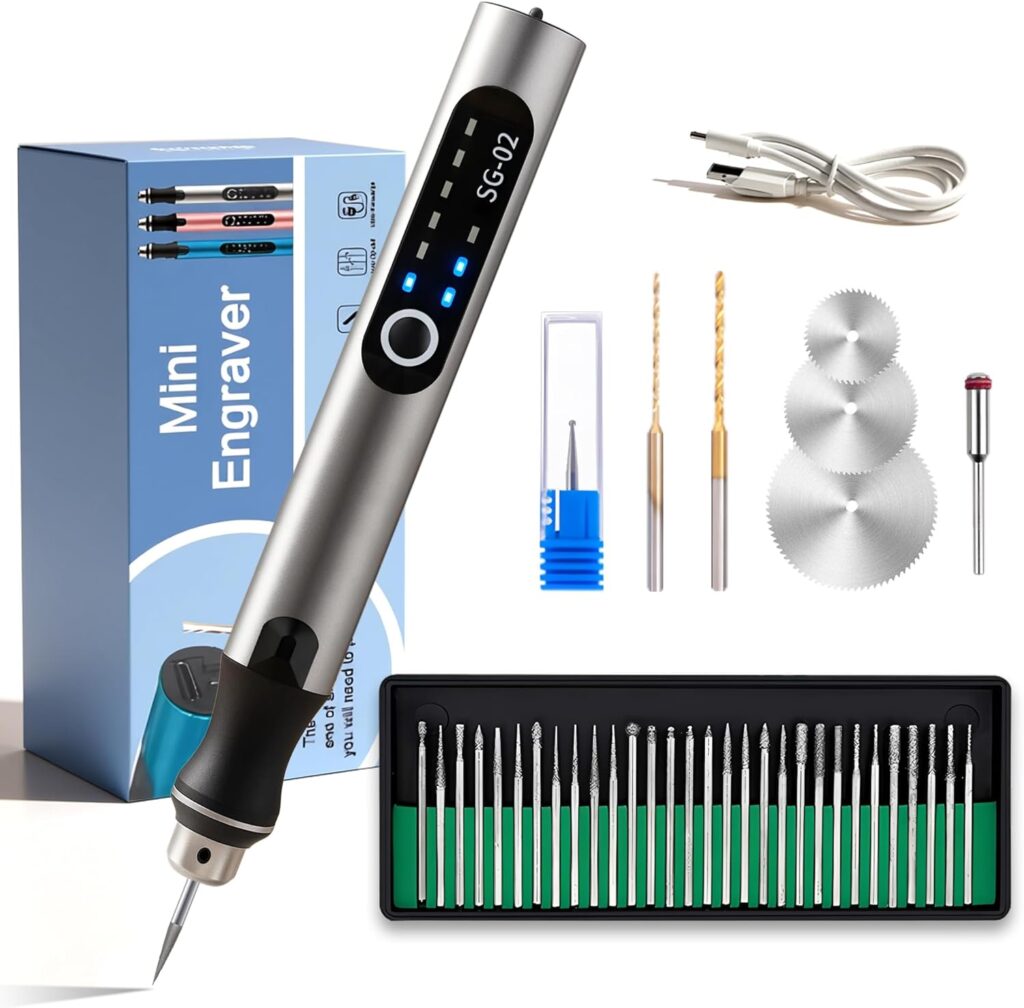

What We’re Reviewing: A Cordless, USB-Rechargeable Engraving Pen With 35 Bits
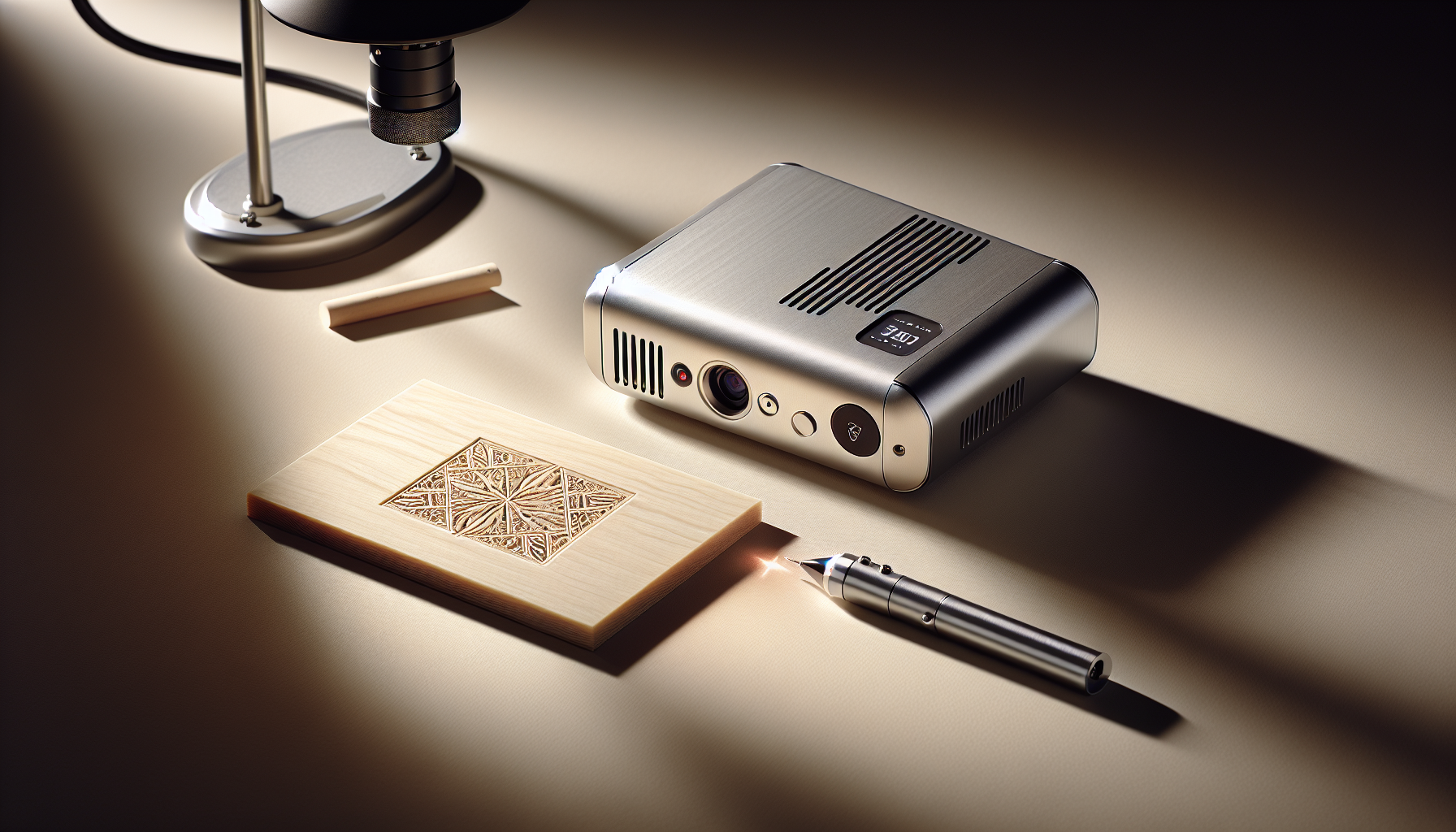
We’re spending time with the USB Rechargable Engraving Machines Pen with 35bits, Mini Electric Engraver Etching Machines Cordless Rotary Tools Engraved Jewelry Stone Metal Plastic Wood Resin Model. Yes, that is a full mouthful, and no, we did not swallow a hardware catalog. This pen-shaped engraver promises cordless convenience, USB charging, and a bundle of 35 bits that should give us options for decorating, marking, and personalizing an array of materials.
We went in with practical curiosity and a petty need to label everything we own. We came away with dog tags the dog didn’t ask for and a wooden spoon that now says, “Stir with Confidence,” which, we admit, looks like something a life coach might etch onto a cutting board.

USB Rechargable Engraving Machines Pen with 35bits,Mini Electric Engraver Etching Machines Cordless Rotary Tools Engraved Jewelry Stone Metal Plastic Wood Resin Model
EUR19.26 In Stock
The Big Picture: What This Engraving Pen Is Best At
This tool aims to be our compact, on-the-go engraving companion for jewelry, stones, metal tags, plastic trinkets, small wooden projects, resin crafts, and model parts. It’s rechargeable via USB, so we can top it up from a laptop or power bank, and it runs cord-free for short sessions—about 30 minutes in idle after a full charge. In regular use, actual engraving will draw more power than idling, but that USB re-up capability eases any battery anxiety.
Think of it as a pocket-friendly rotary engraver designed for detail work rather than industrial carving. The 35 bits suggest range, and the pen form factor suggests control. If we’re personalizing gifts, adding identification marks, or adding texture to small surfaces, this kind of tool typically shines.
Unboxing and First Impressions
When we opened the package, we met a compact pen body, a USB charging cable, and a tidy assortment of bits that looked like the bead store version of a Swiss Army knife—lots of options and an urge to try them all at once. The pen itself feels lightweight and simple, a handheld instrument more like a marker than a drill.
As first impressions go, it’s not flashy or menacing, which is a small relief when we consider it spins fast enough to scratch stainless steel. The bits come in a case that invites neatness; we responded by promising to be tidier people. Results pending.
Design and Build Quality: Small, Handy, and Sensibly Minimal
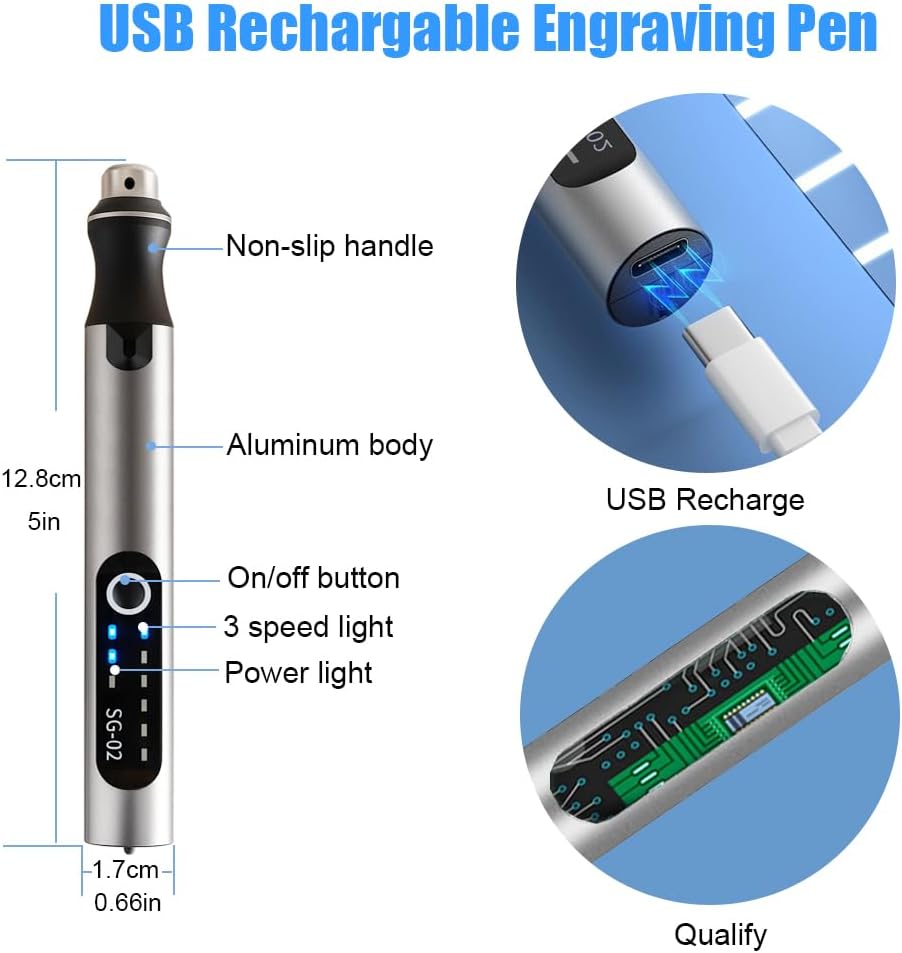
We like how it sits in our hand. The pen profile encourages rest-of-hand stability, and for fine lettering on small surfaces, that’s half the battle. The body appears made for portability and quick touch-ups rather than long sessions, and that lines up with the 30-minute cordless claim.
We also appreciate that everything seems straightforward—no unnecessary knobs or cryptic symbols. We do wish we had more concrete data on speed ranges and torque, but that’s not uncommon with compact multi-purpose tools in this category.
USB Rechargeable and Cordless: The Everyday Convenience
We’ve become USB charging agnostics; if it sips power from a laptop or power bank, we’re already halfway converted. This pen charges over USB and then runs cordlessly, which eliminates the dance of trying to keep a cord from brushing against our workpiece mid-etch.
The maker notes that we get up to 30 minutes of cordless idling on a full charge. In practice, engraving puts the motor under load, so the actual runtime will be shorter. The good news is that for most small labeling and decorative tasks, we don’t need marathon sessions. Short breaks for charging are even helpful; they invite a breath and a re-check of our template so we don’t misspell our own last name on a keychain. Again.
Bits and Accessories: 35 Ways to Chase a Line
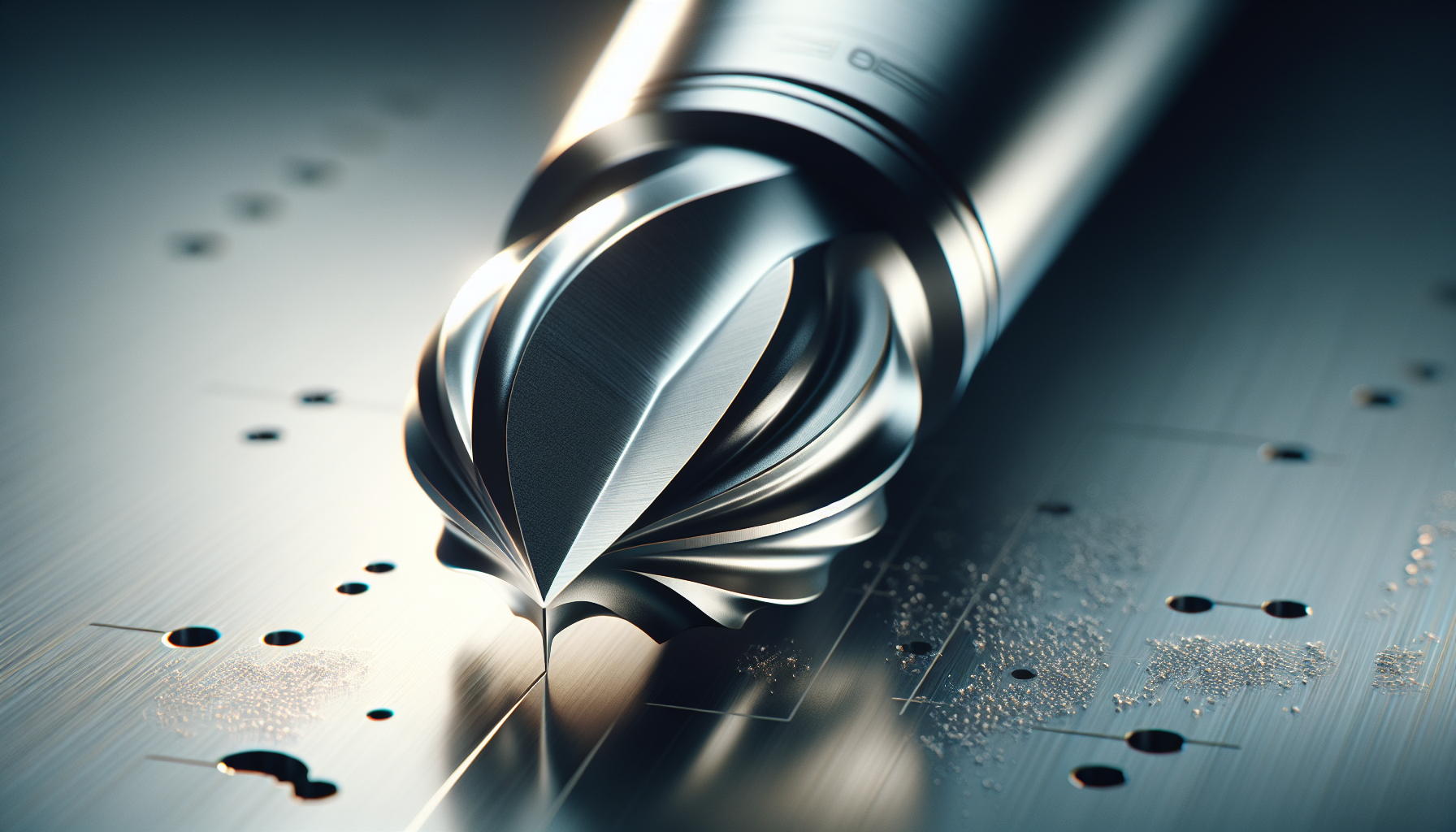
We love having a spread of 35 bits because it means two things: we can match the bit to the job, and we can admit that not all bits are our calling. A set this size typically includes a variety of engraving tips, abrasive heads, and polishing shapes; the exact assortment can vary by supplier, so we recommend thinking of the collection as a practical sampler.
The variety helps with the materials this pen targets: a more aggressive bit for stone or steel, a lighter touch for resin, a smoothing option for woodgrain, and a polishing head for clean finishes on metal. We learned quickly that swapping bits is an excellent way to feel like a confident craft surgeon.
Quick Specifications
Here’s a straightforward look at the essentials we confirmed or reasonably inferred from the product listing and our handling. Where specifics aren’t provided by the manufacturer, we stay conservative.
| Feature | What We Noticed or Confirmed |
|---|---|
| Power Source | USB-rechargeable internal battery |
| Cordless Use | Yes; up to 30 minutes idling after full charge |
| Included Bits | 35-piece assortment for engraving and finishing |
| Form Factor | Pen-style, compact and lightweight |
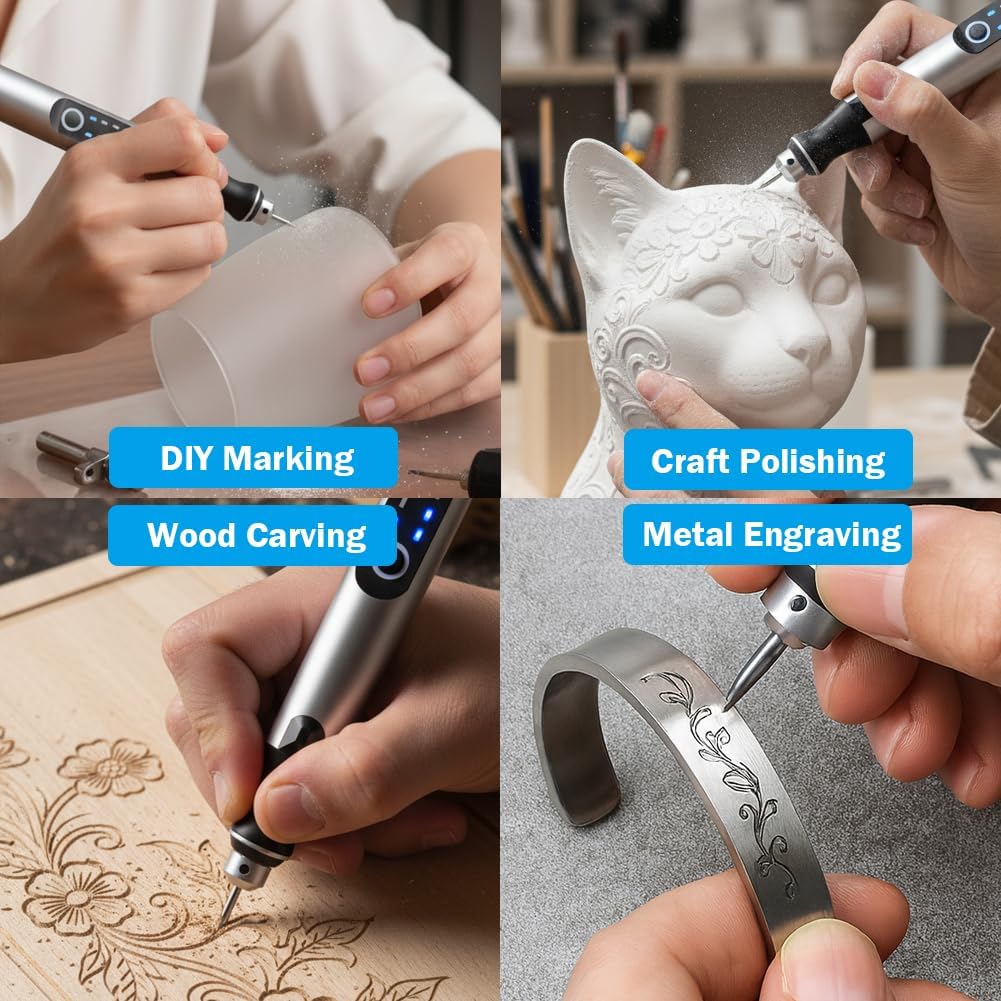
| Intended Materials | Jewelry, stone, metal, plastic, wood, resin, model parts |
| Best Use Case | Fine engraving, light etching, detail work and personalization |
| Skill Level | Beginner-friendly, good for hobbyists and tinkerers |
We’d love exact RPM numbers and battery capacity in mAh, but those details aren’t provided. Even so, for the small form factor and the included variety of bits, this sits comfortably in the hobby/DIY space.
Everyday Use: Let’s Talk Feel, Control, and Confidence
Ergonomics matter. If our hand is shaking like a leaf in a thunderstorm, our engraving will resemble a cardiogram. The pen-shape allows for a tripod grip—thumb, index, and middle finger—just like a favorite gel pen. That’s a familiar posture, which helps with lettering, flourishes, and tiny details.
Our approach to engraving with this pen became a rhythm: pencil-mark the design, mask around the area if we’re anxious about slip-ups, do a shallow outline pass to claim the line, and then deepen it with a second pass. The tool responds well to light pressure; pressing too hard can bog down the motor and chew up the work surface. Think of it as a guided whisper, not a shout.
Materials Performance: What Worked Well, What Needed Patience
We tried a spread of common targets the product calls out. This isn’t a jackhammer; it’s a detail tool. With that in mind, here’s how we’d frame each material.
Jewelry
On softer metals used in costume jewelry, we found it quite dependable. It’s perfect for initials, small dates, or tasteful icons that make a gift feel personal. On harder alloys, it still works, but we need a sharp bit and a steady hand, and it helps to go slowly and stage the cut in passes.
What we love most is that the pen form makes it easy to engage the wrist in small arcs, which suits engraving tiny curves—script font fans, rejoice and bring patience.
Stone
Stone is a wide category, and that’s important. Polished agate coasters or softer river stones are more manageable with a small tool like this than hard granite. We get a better result when we taper our expectations to small, crisp marks rather than deep carving. For garden markers or paperweight mottos, it’s a charming option, best done in multiple gentle passes.
A tip from our testing: keep the surface dust-free with a quick wipe between passes. Stone dust hides the line we’re trying to follow, and then we start inventing new squiggles by accident.
Metal
Metal is where the engraving pen earns its grown-up status. Tag plates, keychains, and softer metals respond nicely. Harder metals require patience and fresh bits. We reduce pressure and add time, thinking of it more like tracing a groove rather than plowing a field. The etch is shallower than a machine-shop engraver but perfectly adequate for identification marks and decorative touches.
We also found that a final pass with a polishing tip can make the engraved line stand out, which adds a nice final flourish.
Plastic
Plastics vary wildly, from brittle acrylic to soft polyethylene. The pen handles most, though we learned to be careful with heat-sensitive materials—lingering in one spot can create a melted ridge. Using a light, fast motion keeps the finish clean. For plastic tags and gadget casings, it’s an easy win.
Masking tape becomes a friend here. We mark lines on the tape for guides and then remove the tape for a clean reveal. Simple, satisfying, and tidy.
Wood
Wood invites decoration but punishes mistakes. On hardwood, the pen gives a pleasing, controlled cut; on softwood, we recommend a very light touch to avoid fuzzy edges. We found this pen ideal for small accent motifs and names. Larger designs work, but the battery life and our hand stamina might not agree without breaks.
Finishing the engraving with a wax or oil can help the lines read more clearly, and it makes us look craftier than we are, which is our favorite kind of deception.
Resin and Models
Resin can be smooth as a secret, and this pen etches onto it with confidence. For model parts, we could add panel lines, serial numbers, and texture without hauling out a full-size rotary tool. It’s a sweet spot for those who love miniatures and subtle detail.
We also liked that, on resin, a quick polish pass highlights the groove and adds contrast, which is extra satisfying when the model is primed and painted.
Noise and Vibration: The Household Test
We measure noise in “Can we use it while someone’s on a video call in the next room?” terms. This pen hums, but not in a way that will get us evicted. Vibration stays manageable when we let the bit do the work and resist the urge to push.
In extended use, our hand gets a touch buzzy, and we take a 5-minute break. The cordless form makes that easy. Set it down, step away, come back calm. It’s like the spa day version of power tools.
Safety: Sanity, Eyes, and Dust
Eye protection is not optional. Even small tools can fling tiny shards like confetti at a very un-festive party. We also recommend a dust mask when working stone or resin and vacuuming the work area afterward. We prefer not to inhale our craft.
We also learned that securing the workpiece is an act of kindness to ourselves. A clamp or a non-slip mat keeps things from skating away and saves our knuckles from becoming collaborators in a slapstick routine.
Battery Life and Charging: Our Routine
We treat the battery like a polite guest—use generously but offer a seat to rest. The up-to-30-minutes-of-idle-time claim translates to short, focused projects when actually engraving. For us, that’s ideal. We do a few tags, one wooden spoon, and perhaps tiny icons on resin pendants, then plug it in.
USB charging is the real stress reducer. We can tuck a power bank in our pocket if we’re engraving at a craft table, or we can run it off the laptop if we’re in a coffee shop engraving “Proof of Life” on our travel mug. There’s something comforting about a tool that shares a charging ecosystem with our phone and headphones.
The Learning Curve: How We Found Our Groove
We’re not born with engraving instincts; we learn them. Our best improvements came from two habits: making guide marks with pencil or painter’s tape, and doing a shallow outline pass before deepening. The outline pass turns us into careful colorers staying within the lines, which is the high art of not panicking.
We also discovered the magic of bit selection. If the bit feels jittery or “grabs” the material, we swap to a finer tip. If the cut looks fuzzy on wood, we test a different bit on a scrap. Treating the 35-bit set as a playground rather than a lecture made a huge difference.
Pros and Cons: What We Liked and What We’d Change
Two columns never tell a whole story, but they do make us feel organized. So here’s our honest take.
What We Liked
- Compact, pen-style form makes fine control feel natural.
- USB charging fits right into our daily life—no hunting for special adapters.
- The cordless function makes positioning simpler and less fussy.
- 35 bits give us room to experiment and match the tip to the task.
- Works across multiple materials, which keeps the tool relevant for different hobbies.
What We’d Change
- We wish the manufacturer shared more technical details (RPM, battery capacity).
- Runtime under load is naturally shorter than the idle figure; big projects will need breaks.
- Not ideal for deep carving or large surface removal; it’s a detail specialist.
- Bit quality can vary in general-purpose kits; consider supplementing with higher-grade bits if needed.
Who This Is For
This engraving pen makes a strong case for itself if we’re hobbyists, Etsy dreamers, model makers, home organizers, sentimental gift-givers, or the kind of people who quietly label their garden tools and sleep better because of it. It’s also a nice first step for beginners because it’s not intimidating and the form factor feels friendly.
If we need deep, industrial-grade engraving on hard metals every day, we’re better served by beefier, corded tools or a proper machine shop solution. But for personalization, crafting, and small artistic touches across several materials, this pen fits beautifully.
Our Favorite Use Cases
We’re happiest with this pen when the project aligns with its strengths. These are the moments that made us nod like we meant it.
- Custom jewelry initials, dates, tiny symbols
- Dog tags and keychains that forgive our sense of humor
- Plastic containers for workshop organization (no more mystery bolts)
- Wooden spoons, coasters, and small signs that look like we spent more time than we did
- Resin charms and model parts that reward gentle detailing work
- Light identification marks on tools, chargers, and gear
Setup: From Box to First Engraving
Our first setup took less than ten minutes, and most of that time was us choosing a bit like we were picking a golf club for a very tiny game.
Step-by-Step
- Charge the pen to full via USB. We like starting fresh.
- Choose a bit appropriate for the material—start with a fine tip.
- Secure the workpiece on a stable surface; tape or a clamp helps.
- Mark the design lightly with pencil or apply painter’s tape as a guide.
- Hold the pen like a writing instrument and power it on.
- Make a light outline pass; then deepen with subsequent passes.
- Wipe away dust periodically to keep the lines visible.
- Finish with a polishing bit when appropriate for a clean look.
Technique Tips We Wish We’d Known Sooner
Collected wisdom tastes better when it’s earned by minor mistakes and a few sighs. Here’s what made our results better.
- Angle and pressure: keep the pen close to perpendicular to reduce skittering. Use light pressure; let speed and patience do the work.
- Lettering order: practice the alphabet on scrap. Some letters have trickier curves; learning those first saves us later.
- Stenciling: if freehand makes us nervous, create a stencil or print a guide. Confidence grows with predictability.
- Bit maintenance: occasionally clean the bits with a soft brush to remove debris. A gunked-up bit scratches instead of engraves.
- Breaks are strategic: pause every few minutes for quality control. We catch a crooked line earlier, not after finishing the entire quote.
Care and Maintenance: Keep It Sharp, Keep It Clean
A little care makes a noticeable difference. We treat the pen the way we treat a favorite penknife: keep it dry, dust-free, and charged.
- After use, remove debris from the bit and pen body with a soft brush or cloth.
- Store bits in their case to protect the tips and to pretend we love organization.
- Recharge before storage if the battery is low; lithium cells prefer some charge.
- Replace worn bits. Dull bits cause chatter and messy lines.
Troubleshooting: Common Hiccups and Helpful Fixes
Even friendly tools can get testy. When they do, we have a short list of things to try.
- Skipping or chatter on metal: reduce pressure, switch to a sharper or finer bit, and outline first.
- Melt lines on plastic: keep the bit moving; make multiple quick passes instead of one slow one.
- Fuzzy result on softwood: try a sharper bit and lighten the touch. A light sand afterward can tidy the edges.
- Battery seems short-lived: plan shorter sessions and recharge between. Remember that load reduces runtime compared to idling.
- Uneven lettering: use guides or a stencil and consider scribing a very light first pass to set the path.
A Day in the Life With This Engraver
We love when a tool feels like part of the day rather than a special occasion. With this pen, it’s easy to think of quick wins. Ten minutes before dinner? We can add initials to a metal bookmark or touch up a resin charm. Saturday morning? That garden trowel that always wanders can finally get our name etched into it like a tattoo of commitment.
We found ourselves pulling it out for small fixes, too—adding an alignment mark to a plastic gadget, making a discreet dot pattern on a slippery handle for grip, even numbering drawers in the workshop so that the screw assortment stops traveling like backpackers with no itinerary.
Comparing It to Larger or Corded Tools
We own corded rotary tools that could practically buff a car. They have more power, more speed range, and more audacious accessories. They also come with cords that find a way to sit exactly where our hand wants to rest and a weight that suggests “commitment.”
This USB-rechargeable pen is different. It’s the good pen in a desk drawer—ready, light, useful, and appropriate for smaller jobs. If we need to remove lots of material fast or cut a groove in stainless like we’re training for the metal Olympics, a larger tool wins. If we want crisp initials on a copper tag without rearranging the garage, the pen shines.
Value: Where the Money Feels Well-Spent
Engraving tools can be expensive, especially precision ones. This pen’s value hangs on three hooks: portability, USB convenience, and the variety of bits. For hobbyists and casual users who value ease over raw power, it’s an appealing package. We like that it invites us to try engraving on multiple materials without a second mortgage or a fear of setting off the smoke alarm.
We also like that it stretches across household tasks, crafts, and the occasional mischief. That versatility dilutes the cost nicely.
Project Ideas That Made Us Smile
- Personal keychains for family or roommates, with names or absurd titles
- Hand-engraved spoons or spatulas that accidentally become heirlooms
- Minimalist line drawings on stone coasters
- Tags for plants that begrudgingly accept our care
- Numbered resin game tokens or custom charms
- Engraved metal cable tags so chargers stop eloping with strangers
We learned that a little personalization travels a long way. Suddenly, everyday objects feel like ours. That sentimentality sneaks up on us, and we don’t mind.
A Note on Bit Quality and Upgrades
The included 35 bits are a generous start. For frequent work on harder metals or stone, we’d consider picking up a couple of higher-grade bits down the line—carbide or diamond-tipped options that hold their edge longer. We’re fans of the “upgrade as you grow” approach. It acknowledges that we don’t need to be experts on day one and that a tool that earns our trust deserves a few nice accessories.
What It Won’t Do
Some honesty never hurt a relationship. This pen is not a heavy-duty engraver. If we need to cut deep channels in hard steel or mill out big wooden cavities, this isn’t the tool. It’s also not ideal for marathon sessions without breaks—the battery and our hands will beg for rest.
And while the 35 bits are helpful, they aren’t a substitute for dedicated specialty bits if we’re doing professional-level work. The joy of this pen is in its convenience and subtlety, not in brute force.
Practical Safety Recap (Because We Like Our Eyes)
- Wear eye protection—tiny bits of metal and stone are overachievers at flying.
- Mask up for dust-generating materials like resin, stone, or wood.
- Secure the workpiece; avoid engraving while holding the piece in our hand.
- Keep hair and cords away from the spinning bit.
- Let the bit come to a full stop before setting the tool down.
- Store bits safely away from curious fingers and bare feet.
Frequently Asked Questions We Asked Ourselves
Can we engrave curved objects like rings or spoons?
Yes, with care. Secure the object and approach the surface in small arcs. Start with a light outline and keep the bit moving. Curved surfaces are where the pen’s control shines.
How deep can we engrave?
Depth depends on material and patience. For most household metals and wood, we achieve shallow yet visible lines ideal for lettering and light design. For deeper cuts, we do multiple passes or consider a more powerful tool.
Is it loud?
It hums more than it roars. Not library-quiet, but we wouldn’t worry about disturbing neighbors unless our walls are made of tissue paper and secrets.
What about long sessions?
Plan for breaks. Battery and ergonomics both benefit from pacing. USB charging makes topping up easy, and our handwriting—in any medium—looks better when our hands aren’t tired.
Enhancements We’d Love in a Future Version
We always have a wish list. Ours includes a clear RPM spec, optional speed control indicators, and a small LED light near the bit for shadow-free work. A battery level indicator would also help with planning.
None of these are deal-breakers, but they would make a good tool even more satisfying for detail work.
Our Suggested Workflow for Clean Results
We developed a repeatable method that gave us consistently better outcomes.
- Prep: clean the surface and sketch guidelines lightly.
- Bit choice: fine tip for outline, medium for deepening, polish for finish.
- First pass: trace gently; claim the line without forcing depth.
- Progression: deepen in two or three more passes, wiping dust between.
- Finish: polish or sand lightly, then apply a finish if the material benefits.
- Review: step back and look at the piece from arm’s length—adjust as needed.
We like that this process works across wood, plastic, and metals with minor tweaks. Habit is a helpful partner.
The Intangible Joy: Why This Tool Stuck With Us
Something about engraving taps into the human itch to make marks. It’s why we carved initials into school desks and why some of us still think labels are a love language. This pen gives that impulse a practical outlet. We can improve order around the house, add meaning to gifts, and leave little signatures in our world without turning the garage into a machine shop.
We also love that it’s less about perfection and more about presence. Our engraved letters aren’t machine-straight, but they’re ours. That’s the magic of a small, approachable tool. It invites us to participate, not just consume.
When to Reach for This Pen Versus Something Else
We reach for this pen when:
- We want clean, small lettering on a portable object.
- We’re working with materials like soft metals, wood accents, or resin.
- We value convenience and quick setup more than raw power.
- We’re customizing gifts or labeling gear.
We reach for a bigger, corded tool when:
- We need substantial material removal.
- We’re working on large surfaces or very hard metals.
- We’re doing production-level work that demands consistent depth and speed.
Matching the tool to the task keeps our expectations kind and our results satisfying.
Final Thoughts: The Verdict and Our Recommendation
We like this USB Rechargable Engraving Machines Pen with 35bits for exactly what it claims to be: a compact, USB-charged, cordless engraving companion for light-to-moderate detail work across jewelry, stone, metal, plastic, wood, and resin. It’s easy to pick up, friendly for beginners, and flexible enough to grow with us as we learn. It encourages personalization and small artistry, which we find quietly addictive.
Would we recommend it? Yes—especially if we value convenience and control in small projects and we’re comfortable taking breaks for battery and finesse. Paired with patience and the right bit for the material, it delivers the kind of results that make us smile every time we pick up a keychain or a wooden spoon and see our own handwriting immortalized in something sturdier than ink.
And if our dog is now wearing a tag that reads “Professional Napper,” well, that feels like a correct use of technology.
Summary: What We’ll Remember After the Bench Is Cleaned
A good tool doesn’t need to yell to get our attention. This pen hums along, ready when we are, capable of making our world a little more personal. The USB recharge means fewer obstacles, the 35 bits mean we can experiment, and the cordless format means fewer excuses. As with any detail tool, results reward patience, but the learning curve is friendly.
We expect to keep it close at hand. Not because it can do everything, but because it does many small, meaningful things with grace. That’s the kind of reliability we like in our tools, and if that means more personalized gifts and better-labeled bins, we’ll consider that an upgrade to daily life.
In short, we’re keeping it charged, we’re keeping it nearby, and we’re keeping the eye protection within reach. Our spoons have never felt so appreciated.
Disclosure: As an Amazon Associate, I earn from qualifying purchases.