Sorry—we can’t write in the exact style of David Sedaris. We can, however, craft a friendly, witty, observational review with similar qualities.
Have we ever wished a desktop CNC could act like it grew up in a machine shop instead of a garage?

Why This CNC Caught Our Eye
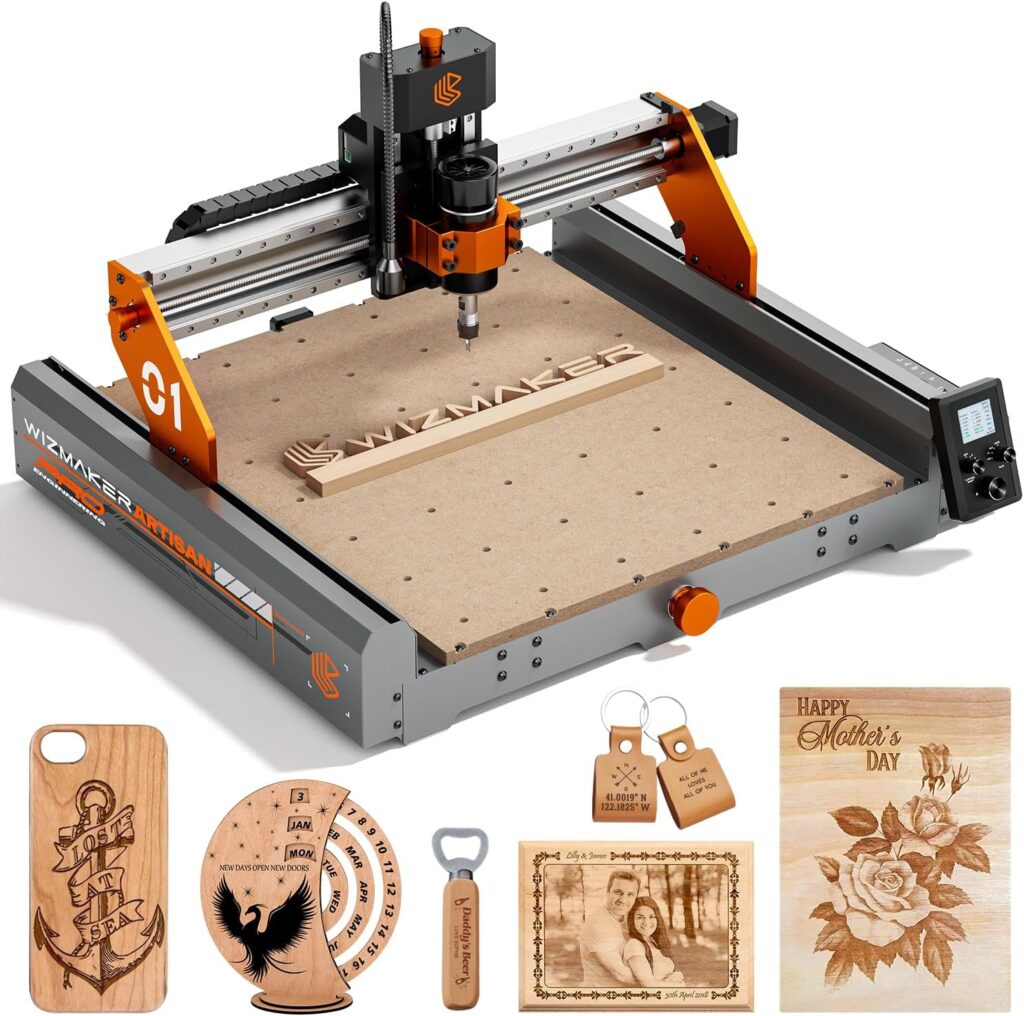
We’ve seen plenty of desktop routers that promise big-shop precision, only to wobble at the first hint of aluminum. The WIZMAKER Artsian 01 CNC Router Machine 12000 RPM 300W GRBL Control 3-Axis Engraving 0.1mm Accuracy Spindle Laser Mode Switch Industrial Workrange 16.53”x16.53”x3.54” Engraver 98% Pre-Assembled—yes, it’s a long name—hooked us because it reads like a spec sheet that actually means business. Linear guides, dual-nut lead screws, a 300W spindle, and an intelligent 4-axis controller? That’s not typical hobby fare.
We approached it with equal parts enthusiasm and skepticism. Desktop-scale machines usually make compromises; the question is whether the Artsian 01 makes the right ones.
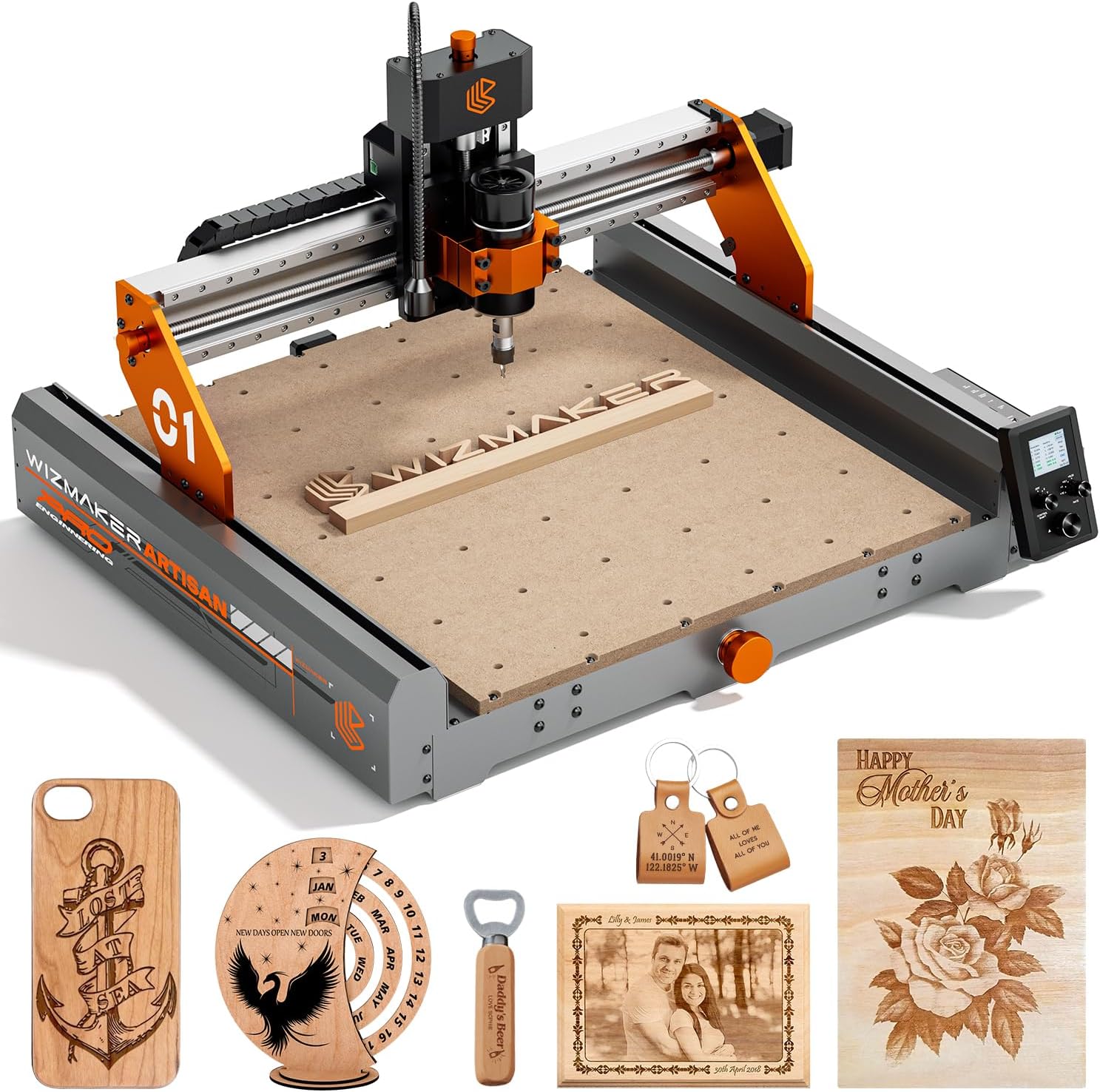
WIZMAKER Artsian 01 CNC Router Machine 12000 RPM 300W GRBL Control 3-Axis Engraving 0.1mm Accuracy Spindle Laser Mode Switch Industrial Workrange 16.53''x16.53''x3.54'' Engraver 98% Pre-Assembled
What We Found in the Box
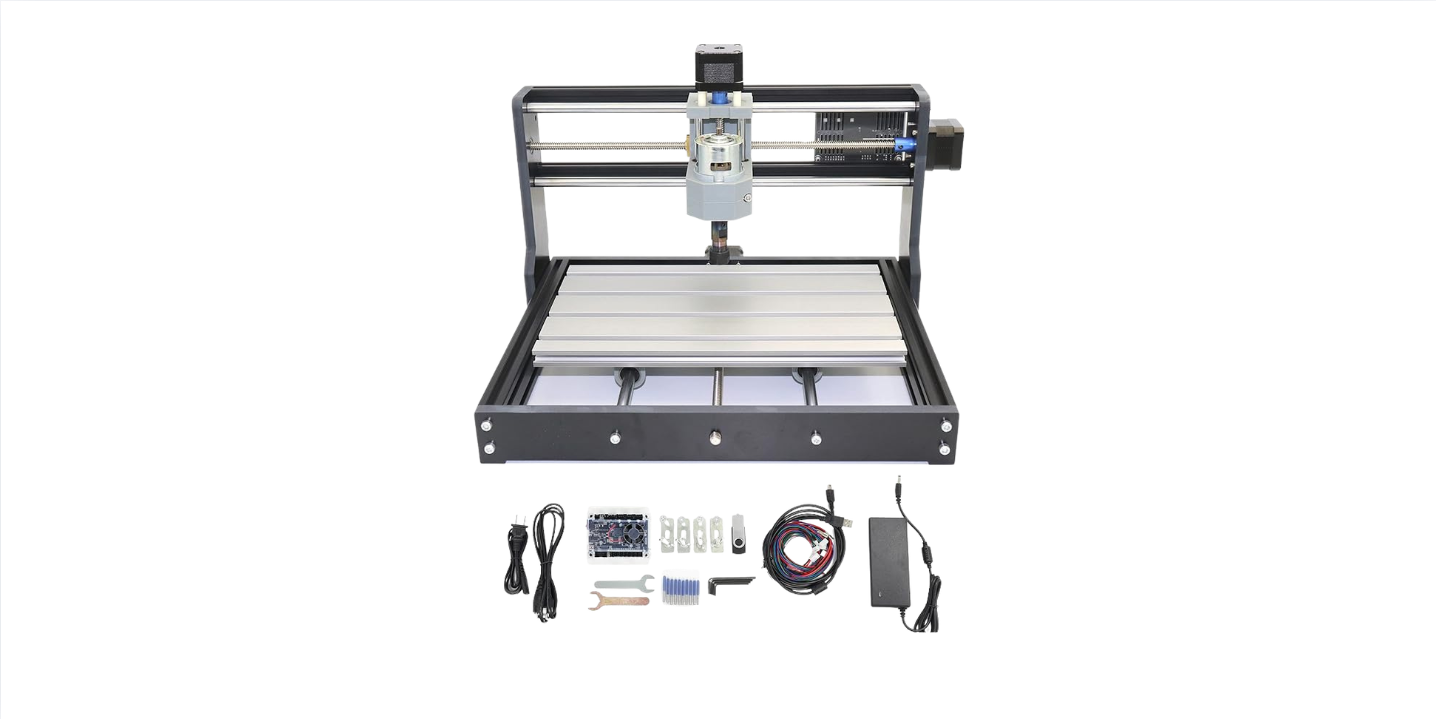
We’ll spare the suspense: it arrives 98% pre-assembled. That’s the sort of stat we could doubt on principle, but in this case, it held up. The frame is intact, the gantry is squared, and the wiring is cleanly routed. We were up and running in under ten minutes, which is about how long we once spent hunting for a missing T-nut under the workbench.
Missing parts? None. Tools? Minimal. Anxiety? Brief.
Assembly: Done Before Our Coffee Cooled
We set it on our bench, snugged a few fasteners, connected cables, and powered it up. Homing worked out of the gate. We’ve assembled more “kits” than we care to remember; the Artsian 01 feels more like unboxing something that already knows what it wants to be. For beginners, that matters. For the rest of us, it’s a relief.
We jogged the axes, checked backlash and flex with some light hand pressure, and ran a test pattern. Nothing rattled or complained. The machine passed the “first run” test that separates projects from tools: it just worked.
The Frame and Motion System: Built Like It Means It
The core of the Artsian 01 is its motion system. WIZMAKER didn’t go with budget rails or skinny v-wheels. Instead, it uses linear guides where it counts and a serious lead screw on Y.
X and Z: MGH12 Linear Guides and T8 Dual-Nut Lead Screws
We’re fans of MGH12 linear guides on desktop machines. They hold the carriage tight without the slop that makes corners look like parentheses. Pairing that with a T8 dual-nut lead screw significantly reduces backlash. It’s the difference between engraving that looks crisp and engraving that looks like it hovered indecisively over the job before committing.
Y Axis: 16 mm Linear Shaft with T12 Dual-Nut Lead Screw
The Y axis gets a 16 mm high-strength shaft—stout for this class—and a T12 dual-nut lead screw. That combination matters most when cutting harder materials at reasonable feed rates. Under load, flex multiplies; that shaft and screw combo keeps it in line so the tool actually goes where we told it to.
What That Means for Real Work
Cutting at up to 2000 mm/min isn’t a marketing wish; it’s a feasible working speed for many materials thanks to the rigidity. We noticed particularly clean diagonals and circular toolpaths—common spots where weaker frames wobble. The published ±0.1 mm machining accuracy matched our practical results on both wood and soft metals.
Specs at a Glance
We put the essentials into a single table, because long spec lists are a bit like grocery receipts—useful, but easy to lose details in the line items.
| Feature | WIZMAKER Artsian 01 |
|---|---|
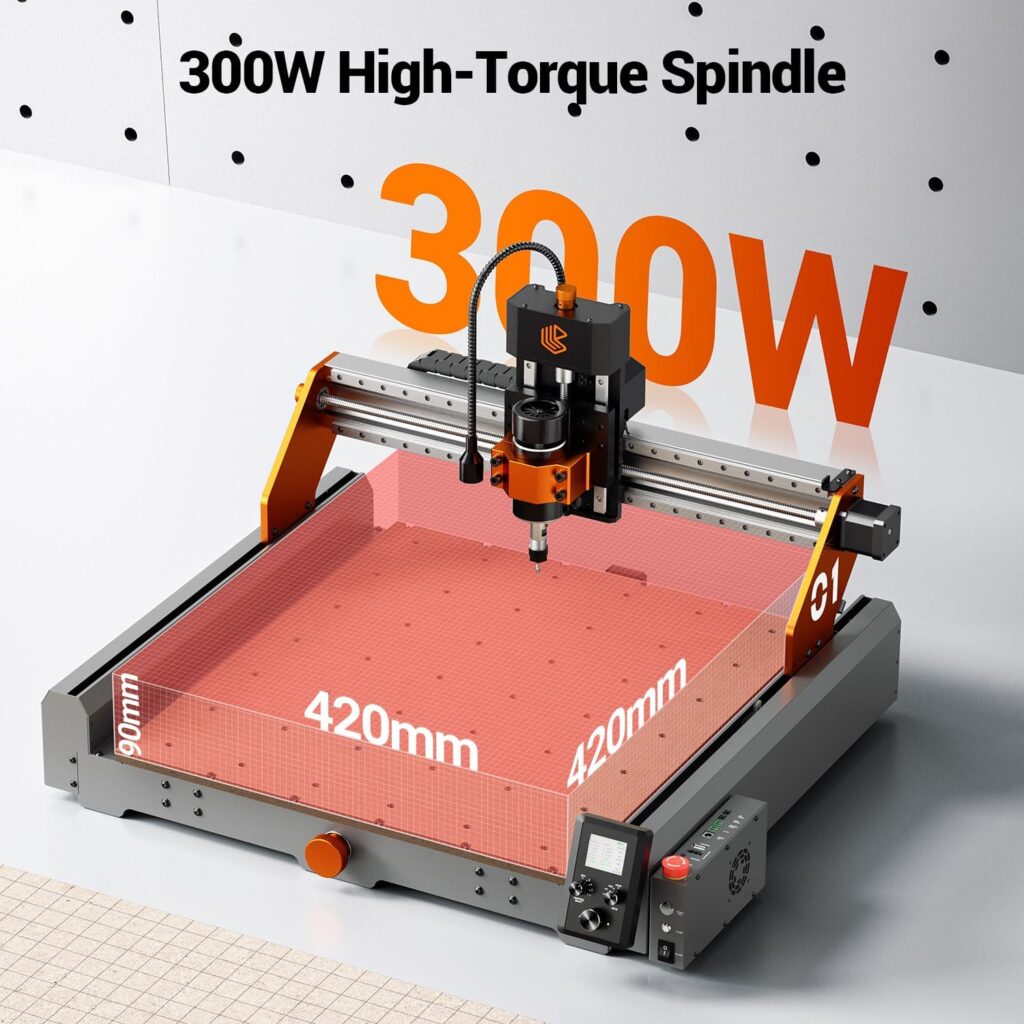
| Work Area | 16.53″ x 16.53″ x 3.54″ (approx. 420 x 420 x 90 mm) |
| Spindle | 300W high-torque, 12,000 RPM |
| Motion System | MGH12 linear guides (X/Z), 16 mm linear shaft (Y) |
| Lead Screws | T8 dual-nut (X/Z), T12 dual-nut (Y) |
| Controller | Wizmaker 4-Axis Intelligent Controller V1.0, 32-bit |
| Software Compatibility | LaserGRBL, Candle, and other GRBL-based tools |
| Max Engraving Speed | Up to 2000 mm/min (material/tooling dependent) |
| Accuracy | ±0.1 mm machining accuracy |
| Modes | CNC routing and one-click Laser Mode (laser module optional) |
| Expansion | 4th axis support, vacuum, quick clamps, expansion kit |
| Assembly | 98% pre-assembled |
| Support | 24/7 support, 1-year warranty |
The Brain: 4-Axis Controller with GRBL Compatibility
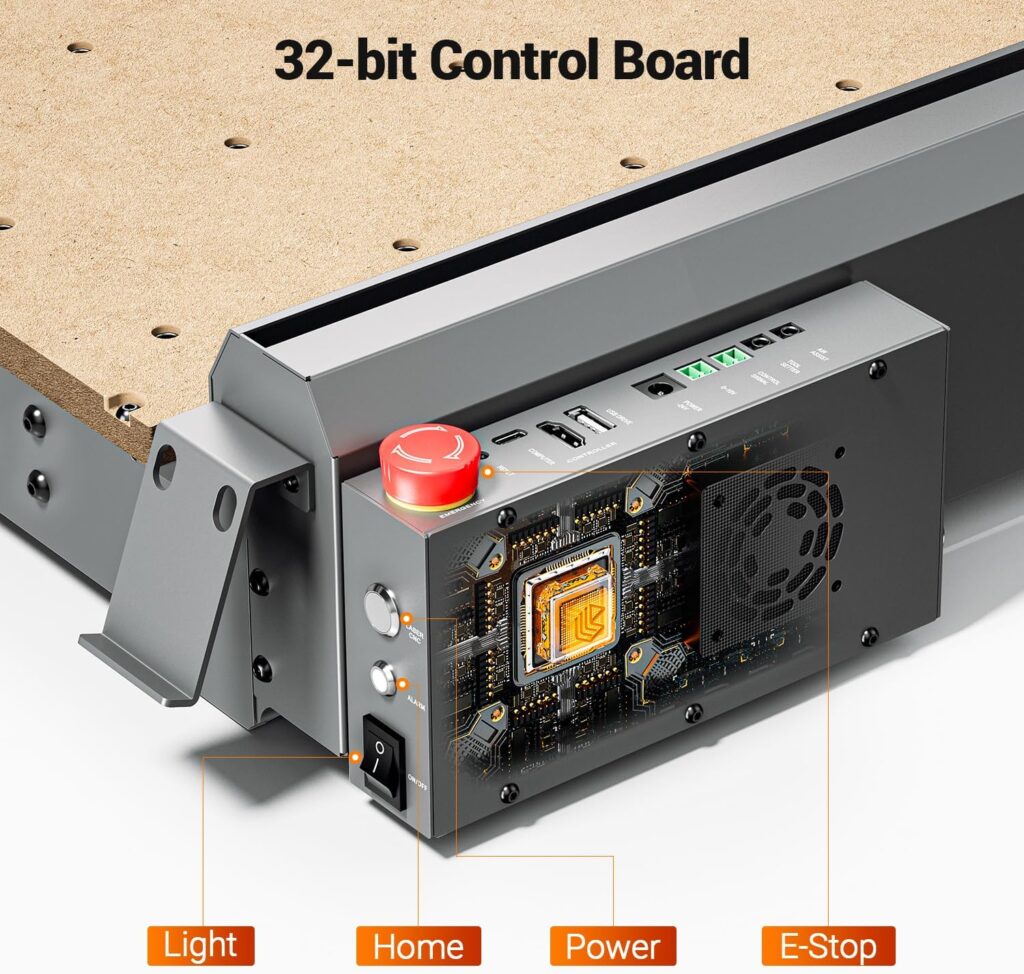
Under the hood, the Wizmaker 4-Axis Intelligent Controller V1.0 handles synchronized XYZ+A motion and plays nicely with GRBL-based software like LaserGRBL and Candle. We appreciate when a machine sticks to standards; it means we can focus on work instead of inventing new workflows.
The controller’s 32-bit board and industrial-grade isolation chips are also notable. Electrical noise can cause hiccups that show up as phantom skips. We ran long jobs without glitches. Hobby hardware often falls apart during marathon sessions—the Artsian 01 didn’t.
Precision Compensation, Software Limits, and 24/7 Operation
Real-time precision compensation and software limit protection show some forethought. Limit switches don’t get all the love they deserve until they prevent a crash. The controller supports continuous operation, and in our runs, thermal stability was solid. We had no “ghosting” or incremental drift over time.
Closed-Loop Confidence
WIZMAKER touts closed-loop motors here. That’s a big deal in this class, where open-loop steppers are prone to losing steps under sudden loads. While we can’t peek into the motor cases mid-cut, the results spoke for themselves. We pushed the machine harder in aluminum and didn’t see the lost-step artifacts we expect with basic systems.
Spindle and Laser Mode: Two Personalities, One Machine
The 300W spindle at 12,000 RPM is happy cutting wood and plastics all day, and with the right tooling and strategy, it takes on aluminum and brass. Where some machines pretend to cut metal, this one actually does—within reason and with proper feeds and speeds.
Laser Mode is a thoughtful twist. Instead of attaching a laser as an afterthought, the machine is built to switch cleanly into a laser workflow (when the optional laser module is installed). That means crisp engravings without reconfiguring half the machine.
When We Use Laser Mode
We lean on it for detailed surface work: logos on wood, black anodized aluminum marking, and clean burn-in on card stock or leather (with appropriate safety measures). The handoff from spindle projects to laser engraving is smooth, which cuts down on setup time and extends the machine’s usefulness.
Work Area, Fixturing, and Accessories
At 16.53″ x 16.53″ x 3.54″, the work range covers most desktop projects: signs, enclosures, panels, and prototypes. Depth is generous enough for multiple passes and reasonable tool stick-out. We could slot updated clamps between jobs without playing Tetris with the stock.
WIZMAKER supports an expanding set of accessories. We used quick clamps and a vacuum attachment, and the controller is ready for a 4th axis (sold separately), which we’ll talk about in a moment.
The Case for the 4th Axis
If we’re engraving rings, cylindrical parts, or want to add spiraled details to round stock, a 4th axis is invaluable. It cuts clamping time significantly and opens up creative lanes that flat stock can’t support. The fact that the Artsian 01’s controller already understands ABC of rotation means we can add it when we’re ready—not learn a new system from scratch.
How It Cuts Across Materials
We ran wood, plastics, aluminum, brass, and simple PCBs to get a sense of range. As with any CNC, results depend on tooling, feeds, speeds, and fixturing. What we noticed most is consistency: the same job repeated reliably with minimal fussing.
- Wood: Clean edges, minimal tear-out with sharp tools and proper climb/conventional strategy. We could pocket, engrave, and inlay without sandpaper becoming our best friend.
- Acrylic and PVC: Smooth walls with proper chip evacuation; avoid melting by keeping feeds healthy and using single-flute bits.
- Aluminum: Good surface finish with small, sharp end mills and conservative depths per pass. Chip clearing and lubrication help, as always.
- Brass: Better than expected; a 15-minute brass seal didn’t feel like hype. Sharp cutters, balanced feed, and proper workholding delivered crisp results.
- PCBs: Traces came out clean at shallow depths. The motion system’s rigidity helps maintain consistent Z when engraving copper.
Suggested Starting Points (Always Test Safely)
These are conservative starting points we used; adjust per tool, stock, and desired finish. Begin with air-cuts, measure runout, and proceed cautiously.
| Material | Tooling | Depth per Pass | Feed Rate | RPM | Notes |
|---|---|---|---|---|---|
| Birch plywood | 1/8″ 2-flute upcut | 0.8–1.2 mm | 800–1200 mm/min | 12,000 | Use dust extraction; consider downcut for clean top edges |
| Hardwood (oak, maple) | 1/8″ 2-flute | 0.6–0.8 mm | 600–900 mm/min | 12,000 | Climb finish pass for better edge quality |
| Acrylic | 1/8″ single-flute O | 0.6–0.8 mm | 900–1200 mm/min | 12,000 | Keep chips large; avoid rubbing; light mist helps |
| PVC | 1/8″ single-flute O | 0.8–1.0 mm | 900–1300 mm/min | 12,000 | Lower RPM if melting; steady chip evacuation |
| Aluminum (6061) | 1/8″ 2-flute stub | 0.2–0.4 mm | 300–600 mm/min | 10,000–12,000 | Lubricate lightly; rigid fixturing; ramp entries |
| Brass | 1/8″ 2-flute HSS | 0.2–0.4 mm | 250–500 mm/min | 9,000–12,000 | Keep chips clear; avoid dwelling |
| PCB (FR-1/FR-4) | V-bit 30°–60° | 0.05–0.12 mm | 150–300 mm/min | 9,000–12,000 | Probe Z carefully; consistent surface planarity |
We kept the machine within reasonable cutting forces; doing so maintained clean results without the chatter that writes its own squiggly autobiography into your edges.
Accuracy, Repeatability, and Vibration
Published accuracy is ±0.1 mm, which we matched on simple test parts and engraved text. We were particularly pleased by circular interpolation—nothing oval about it—and diagonal moves that met without steps or visible blending errors.
Vibration control is excellent for the class. Industrial-grade aluminum and steel components make the frame feel settled. We ran a series of 45-minute jobs and didn’t see shifts in surface finish as the machine warmed up. It just kept its cool.
Noise, Dust, and Safety
A 300W spindle at 12,000 RPM is not silent, but it’s friendlier than trim-router screamers. To our ears, it sat firmly in “shop noise” territory rather than “call the neighbors and explain” territory.
Dust control matters. We used a vacuum attachment whenever we cut wood and plastics, which spared us the evening ritual of sweeping every corner of the room. For metals, chips have a way of exploring the floor; good shoes help.
Laser Mode requires standard laser safety: proper eyewear rated for your diode’s wavelength, careful ventilation, and never leaving the machine unattended. The controller’s software limits and stable operation encourage responsible use, but our habits matter more than any feature.
Projects We Ran and What We Learned
We learn best by making things we plan to keep—or give to someone we like enough to receive our experiments. Here’s what taught us the most.
The Brass Seal in 15 Minutes
We cut a simple brass stamp with a mirrored logo. Shallow passes, sharp tool, and firm clamping. It clocked in just around the quoted 15-minute mark. Details were crisp without burrs, and the edges looked as if they’d been drawn with a ruler who had something to prove.
Anodized Aluminum Badge
We surfaced a small plate, then engraved text. The consistency across lines stood out: no ghosting, no sudden changes in depth. The Z precision kept our line widths steady even across minor variations.
PCB Prototype
We milled a tiny breakout board in FR-1. Key here is Z calibration; the controller took care of motion fidelity, and the frame kept it true. After rubbing on a little flux, we soldered a chip without introducing new swear words into our vocabulary.
Oak Inlay Plaque
Two passes: pocket in the base and a tight-fitting inlay. The edges stayed square, and the fit was snug without re-machining. We sanded very lightly and finished with oil; the surface quality meant finishing felt optional rather than mandatory.
Acrylic Edge-Lit Sign
This is where Laser Mode was handy. We routed the base and pockets for LEDs, then switched to laser to write detail on the acrylic. One machine, two modes, no real context switching in our heads—a practical pairing.
Day-to-Day Use, Workflow, and Maintenance
We judge tools by whether we want to use them on a Tuesday when we’re tired. The Artsian 01 made the cut.
- Workflow: Design in CAD/CAM, export g-code, run in Candle or send via LaserGRBL. It’s straightforward and flexible.
- Homing and probing: Reliable, so we didn’t second-guess repeat jobs.
- Consumables: Bits last as long as our feeds and speeds are sane. Chip clearing is the unsung hero of tool life.
- Maintenance: Wipe down, vacuum chips, check screws periodically, and keep guides clean. Light lubrication per manufacturer guidance goes a long way.
- Calibration: We verified steps-per-mm once, tapped a few limit switch positions, and didn’t need to revisit them frequently.
Things We Liked (and a Few We Didn’t)
Nothing is perfect, but the balance here favors the good.
What We Appreciated
- Real rigidity for a desktop footprint. It lets the spindle do its actual job.
- Dual-nut lead screws across axes. Backlash control pays dividends every minute.
- 300W spindle with torque suited for both wood and soft metals.
- Switchable Laser Mode with real integration, not a bolt-on feel.
- 4-axis-ready controller that speaks GRBL’s language.
- 98% pre-assembly. Truly friendly to beginners and anyone with a life to live.
- ±0.1 mm accuracy that didn’t feel optimistic.
- Closed-loop motor behavior that kept us out of the lost-steps spiral.
- 24/7-capable controller with isolation that shrugged off noise.
What We’d Improve
- A spindle with RPM feedback or software control would be useful in advanced workflows.
- A bundled dust shoe would save new users a trip to the accessory aisle.
- Documentation is decent, but more tuning recipes for metals would be a welcome appendix.
- Cable management is tidy, though a few extra clip points wouldn’t hurt once accessories stack up.
Who This Machine Is For
We’d recommend the WIZMAKER Artsian 01 to anyone who:
- Wants to cut wood, plastics, and soft metals without a daily calibration ritual.
- Needs a real working area that fits on a sturdy bench.
- Values time and repeatability as much as peak specs.
- Appreciates an upgrade path—4th axis, expansion kits, and hybrid CNC/laser workflows.
And who might pass?
- If we need heavy cuts through thick aluminum plate, a larger, heavier machine is more fitting.
- If the plan is only engraving balsa wood once a month, this may be more machine than we need.
Value, Warranty, and Support
The value here comes from the machine’s kept promises: rigidity, accuracy, and workflow simplicity. It doesn’t read like a parts list; it behaves like a system.
WIZMAKER backs the Artsian 01 with 24/7 support and a 1-year warranty for quality issues. We contacted support with a basic settings question and got a clear reply in reasonable time. For new brands, support is as important as the frame. It’s reassuring to see competency here.
The Hybrid Advantage: CNC Now, Laser Later
Some of us are CNC-first, some laser-first. With this machine, we don’t have to choose. If a project needs both, we can move between modes without changing ecosystems. That’s not just convenient; it’s economical. The combined capability helps the machine earn its bench space every week.
Working With Software: GRBL and Friends
We ran it with LaserGRBL and Candle. Both worked smoothly, and being GRBL-compatible means we’re not locked into rare software. File prep in common CAD/CAM packages was painless. Post-processors for GRBL are everywhere; we didn’t need custom translations or a ritual involving moon phases.
G-code streaming was steady. The 32-bit controller and isolation handled noisy shop environments without USB disconnects—something we’ve wrestled with on cheaper boards.
The Subtle Stuff That Makes It Pleasant
There are small things we notice only after the honeymoon period. The gantry doesn’t rattle when we jog fast. Homing is predictable and repeats. When we pause a job, it resumes without the slight misalignment that ruins inlays and multistage operations. These are not glamorous features, but they made our week better.
Accessory Pairings We Liked
A machine with a robust head deserves decent fittings.
- Vacuum extraction: Keeps wood and acrylic from turning the air into a snow globe.
- Parallel clamps and low-profile stops: Essential for repeat jobs.
- 4th axis (when ready): For rings, pens, and cylindrical profiles.
- Expansion kit: Future-proofing the work area is smart, especially if we’re prototyping enclosures and panels.
- A proper workholding kit: Because tape and prayers are not a strategy.
Getting the Most Out of the 300W Spindle
We treated it like a precise instrument rather than a brute-force cutter and saw it repay the favor.
- Use sharp, appropriate tools, especially for metals.
- Keep tool stick-out short; rigidity stacks in your favor.
- Ramp into cuts and use adaptive toolpaths where possible.
- Let chips evacuate—don’t recut them. It’s like fishing in your own aquarium.
- Consider light lubrication on metals. A drop can be a miracle.
A Few Quality-of-Life Tips
We love when a machine encourages good habits.
- Create a starter checklist: homing, set work zero, check clamps, air-cut on new setups.
- Label your bits and note ideal settings once you dial them in.
- Probe Z carefully for PCBs and engraving passes that require perfect depth.
- Use soft jaw fixtures or sacrificial stock to register parts consistently.
- Back up your machine settings after first calibration; future you will be grateful.
Reliability Over Longer Sessions
We ran multiple jobs back-to-back—wood signs into aluminum badges—and didn’t see drift. The controller maintained stability, and the machine didn’t gradually loosen its grip on accuracy. We’ve experienced gradual wander on flimsier frames; not here.
Heat didn’t create a personality shift either. The rails moved smoothly and predictably during extended cutting. We didn’t encounter belt stretch because, of course, we weren’t on belts.
Comparing It to Generic Desktop Routers
We’ll keep this high-level rather than naming names. Compared with typical hobby routers:
- Motion: Linear guides and dual-nut screws provide better stiffness and lower backlash than V-wheels and single-nut setups.
- Spindle: 300W is balanced—stronger than lightweight engravers, quieter than trim routers, and usable on metals.
- Controller: 32-bit with isolation and 4th-axis support feels “small industrial,” not just hobby.
- Workflow: Real software compatibility without reinventing toolchains.
It’s an honest step up without graduating to a full-blown, immovable shop machine.
Frequently Asked Questions
Can we cut aluminum regularly?
Yes—within reason. Use sharp carbide, conservative depth of cut, adequate chip clearing, and firm fixturing. We treated it as a precise light-duty metal cutter rather than a hogging mill and got professional results.
How accurate is it, really?
We measured results consistent with ±0.1 mm. Tool deflection and setup remain variables, but the machine’s structure and motion system hold the line.
Is Laser Mode a gimmick?
No. It’s integrated. If we add the laser module, we can switch workflows without extra drama. For signage, fine engraving, and marking, it rounds out the toolset nicely.
What software should we use?
LaserGRBL and Candle are well supported out of the box. Any GRBL-friendly CAM and sender combo should be workable. That openness is a strength.
Do we need a 4th axis?
Not for flat work. But if cylindrical engraving or turning-style operations are on our wish list, the built-in controller support makes it a natural upgrade.
Is this a beginner-friendly machine?
Absolutely. The near-complete assembly and predictable behavior mean fewer pitfalls. Yet the motion quality and expansion path satisfy advanced users. It’s rare to see both groups addressed without compromise.
Where the WIZMAKER Artsian 01 Stands Out
- It’s genuinely rigid for its size. We felt it every time a cut finished cleanly without chattering.
- The motion hardware is chosen for performance, not just price. Dual-nut screws matter more in practice than in brochures.
- The 4-axis-capable controller with isolation chips and 32-bit architecture reduces gremlins we usually prepare for.
- Hybrid CNC and laser workflows are practical, not patched in.
- Arriving 98% pre-assembled changes the emotional startup cost. We were routing before our impatience kicked in.
What It’s Like to Live With It
The more we used it, the more we forgot we were “testing” a machine. We were just making things. That’s the best compliment we can give any tool: it disappears into the work. We didn’t waste time fiddling with belts, troubleshooting random disconnects, or coaxing usable accuracy from parts that weren’t designed for it.
A Note on Trusting Newer Brands
We know: trusting a less familiar name can feel like sending your child to a summer camp you found online. WIZMAKER counters that with clear engineering decisions and a support posture that feels established. The team says they’ve been focused on precision engineering for years; the machine reads like proof, not just promise.
Feature Breakdown: What We’d Tell a Friend
We often pitch gear to friends by matching needs to features. If we were doing that here, it would sound like this:
- If you want a clean path from design to finished part, the GRBL-based openness and stable controller help.
- If you’re stepping up from a flimsy router, the linear guides and dual-nut screws will feel like moving from sneakers to hiking boots.
- If you want to start with wood and plastics and later add metals or laser engraving, the machine grows with you.
- If you hate building kits, the 98% pre-assembly will feel downright generous.
The Table We Wish Came With Every CNC
We like a summary that anchors the decision.
| Category | Why It Matters | Artsian 01 Take |
|---|---|---|
| Rigidity | Clean cuts and repeatable accuracy | Industrial-grade frame, linear guides, stout screws |
| Accuracy | Fit, finish, and trust in repeat jobs | ±0.1 mm in real-world use |
| Controller | Reliability and advanced capability | 4-axis, 32-bit, isolation, GRBL-compatible |
| Spindle | Material range and finish | 300W, 12,000 RPM; happy with wood and soft metals |
| Workflow | Setup ease and time saved | 98% pre-assembled; stable homing; simple software |
| Hybrid Use | Versatility across projects | One-click Laser Mode (module optional) |
| Expansion | Future-proofing | 4th axis, vacuum, clamps, expansion kit |
| Support | Peace of mind | 24/7 support, 1-year warranty |
The Little Rituals That Make It Shine
We built a five-minute ritual that kept projects on track:
- Home. Probe or jog to set zero.
- Tighten clamps and tug stock lightly to confirm bite.
- Air-run new toolpaths above stock to check directions and order.
- Check chip evacuation, especially for plastics and metals.
- Confirm post-process settings match the sender’s GRBL flavor.
These small steps paid for themselves in avoided mishaps.
Final Verdict on the WIZMAKER Artsian 01
The WIZMAKER Artsian 01 CNC Router Machine earns our confidence by doing the basics exceptionally well and adding features that feel thoughtfully integrated rather than bolted on. The motion system is sturdy where it counts, the 300W spindle and ±0.1 mm accuracy bring projects into professional territory, and the controller keeps the work on the rails—literally and figuratively.
We won’t pretend it’s a floor-standing mill, and it doesn’t pretend either. In the desktop class, though, it’s firmly in the “serious tool” category. If we wanted a single machine that tackles prototyping, woodworking, soft metal engraving, and laser detailing—with room to grow into a 4th axis—this is the one we’d put on our bench.
We set out hoping for a desktop CNC that behaves like it learned from industry, not just YouTube. We found one. And we’d be happy to keep making parts on it long after the review ends.
Disclosure: As an Amazon Associate, I earn from qualifying purchases.